AI & The Future of Power, Book review

Book Review: Artificial Intelligence and the Future of Power

This book, Artificial Intelligence and the Future of Power, by the internationally acclaimed author, Rajiv Malhotra, is about the importance and effects of artificial intelligence in India and its future as a nation. Rajiv Malhotra has interesting insights as a person who has studied computer science and done extensive research on India’s history. It makes important revelations on how the advent of artificial intelligence will alter every aspect of our lives, from an international, to national to a personal level.

My Thoughts:

According to the factual history and many sources from offline and online, since the first century BCE, humans have been intrigued by the possibility of creating machines that mimic the human brain. In modern times, the term artificial intelligence was coined in 1955 by John McCarthy. Today, the amount of data generated by humans and machines far outpaces humans’ ability to absorb, interpret, and make complex decisions based on that data. Artificial intelligence forms the basis for all computer learning and is the future of all complex decision-making.

Also Read – Life Lessons From Hazrat Nizamuddin

AI is a computer science branch that deals with creating computers or machines as intelligent as human beings. It refers to the machines’ ability to perform human intelligence processes like thinking, perceiving, learning, problem-solving, and decision making. Thus in simple terms, Artificial Intelligence is the intelligence showed by machines.

In this book, the author explains the conflict between the actual being and the algorithms. He, however, tries to explain,’ most of India’s leaders, public intellectuals, media personalities, policymakers, think tanks and authors are “ignoring the dangers” that lie ahead, “living securely in their comfort zones with like-minded peers”. This could potentially be very dangerous to the nation. This massive 520 pages book, divided into two parts, focused on how India is a battleground with technically sound intelligence being masked psychologically by ridiculing that every aspect being already explained in Yogic science or the Vedic science.

The topics discussed in the book may not please many people or the hard rooted believers, but the effect of AI in their lives is put away appallingly. Unfortunately, many elite people in power also mislead the public. There is so much we have to learn from fellow countries that are advanced in every aspect.

Read More
AI & The Future of Power, Book review

The Bad and the Ugly of AI

‘Some books are to be tasted, others to be swallowed, and some few to be chewed and digested ….’ When Francis Bacon tried to make this distinction, he advised that few books are to be read with diligence and attention for they are invaluable. But he could not have foreseen that there can be one more factor for classification – scary!

Rajiv Malhotra’s Artificial Intelligence & Future of Power is one such book that shakes and scares you. No, he has not written about aliens or ghosts but what the future may actually hold for all of us in this world itself. Artificial Intelligence (AI) can sting. The term AI remains a little-understood phenomenon and most of us take it to be the way it’s depicted in science fictions. Apart from discussing the elementary understanding that the masses have about artificial intelligence, there are several other dimensions of AI which Malhotra touches upon in his book. He writes with proofs and evidence patterns, he quotes AI leaders and big data company owners and then identifies five battlegrounds in his book.

The unleashing of technology through AI will render people jobless simply because they will be deficient in the skill sets needed to work on AI. As well as with AI. Also, contrary to the popular belief, AI will not create more jobs – rather, it will replace less skilled humans as personnel working on AI need to have a certain specific set of skills. At almost every level of ‘work’, AI will replace a certain amount of human workforce to increase production efficiency.

This will widen the already existing socio-economic gap and given the population of India, increased AI usage will lead to serious law & order situation, says the author. Malhotra goes on to the extent of predicting that the world may someday discuss de-populating the earth by eliminating the masses – a ghastly foresight.

Now contemplate a situation where you want to write on social media about the issue of social justice or gender equality and how these notions significantly differ in India from what is applicable in west, but you get a notice that your post contains ‘objectionable material’ so it can’t be published. This might sound familiar but ever wondered how and why it happens? Malhotra has answered it in his book. Social media is driven by algorithms and these algorithms are managed by AI, which in turn is managed by people who have their own biases as they have been born, brought up, trained and made to cherish the western universal notions of everything.

This can largely subvert democracy because democracies have fault-lines. Even a popularly elected mass leader is bound to have critics. But what if AI-driven algorithms started to flag the popular leader’s social media posts as a handful of critics find it to be objectionable? It has already happened in the USA with Trump. AI can, thus, undermine an individual, even a very powerful one.

Big tech companies sit on a mountain of data. Machine learning systems have some implicit and explicit values, norms and ideals that train the algorithms. Analysing an individual’s clicks on social media regarding his likes and dislikes, a pattern can be recognized and predicted and the individual can be easily manipulated accordingly. AI here acts as a force multiplier that strengths whatever values and policies are embedded within it. Specific narratives can be controlled and manipulated by AI. This can result in digital colonisation.

In his earlier books, Rajiv Malhotra has pointed to the western bias and the population parameters through which the west weighs the rest of the world, including India. The disdain western intellectuals and our very own brown intellectuals have for bhartiyata is an offshoot of viewing everything through the western lens. This is what makes yog gross and yoga cool! Western universalism (an assumption built into western thought that are projected as being universally applicable, even though, in reality they are specific to the history and worldviews of the west) has no room for accommodation and in worldview, all the modern self-proclaimed progressive values emanate from the west.

In his latest work, Malhotra lays out how urgently India needs to develop an Indian grand narrative that will serve as the base for its own AI platforms. India currently relies on obsolete European socialist and liberal theories and that is why the social science models taught here are western frameworks that are used to interpret Indian society. Masses in India are not even remotely concerned by AI. I they have heard of it, they vaguely identify with a robot, the sci-fi kind. Malhotra points out that in India, the public concerns over AI-related issues are at the level where concerns for global warming were a quarter of a century ago.

Worst of all, the State seems to be indifferent to this obvious threat. Malhotra mentions that other than the Indian military and the few baby steps taken by the Government thinktank NITI Aayog, no one seems interested. Social Science academics are embarrassed to even discuss AI as they lack even a basic understanding of AI and the general population is ignorant. That’s why Rajiv Malhotra’s book opens with a quote from Ramayana, ‘it is extremely easy to find people who speak pleasantly. But it is rare to find people who speak and hear true words even when they’re not pleasing to the ears’. Hope this book wakes India from its slumber.

Read More
Book review, Book Reviews, Ten Heads Of Ravana

Opinion | ‘Ten Heads of Ravana’: A Brilliant Takedown of Eminent Left-Oriented Scholars

For the past two centuries, Indology has been controlled by Western scholars and institutions, which have applied Western methods to study Indian civilisation. Infinity Foundation has, for the past several years, been at the forefront in the field of civilisational studies, applying the lens of ‘Dharma’ to examine a broad range of topics. “The present book — Ten Heads of Ravana — is the latest offering from our team of brilliant scholars, scholars I have mentored”, says Rajiv Malhotra.

The title of this collection, Ten Heads of Ravana, has been chosen with care. The use of ‘Ravana’ is intended as a parody and not literally. The metaphorical resemblances are clear — the historical Ravana disrupted society’s Hindu structures, and the ‘heads’ chosen for this book are considered by Hindus, today, to be individuals doing something similar, but intellectually and not with physical violence.

The ten scholars featured in this book are powerful in the academic discourse today; they have worked diligently most of their lives to develop their intellectual ‘weapons’, and their impact is not to be trivialised. There is no intention on the part of the authors to attack the individuals at a personal level, but rather to cast their work in the framework from the perspective of Dharma. The authors of these essays have taken care not to engage in any ad hominem attacks or unprofessional takedowns of the individual scholars. Ramayana, one of the greatest mahakavyas of Bharat, shows us the nature of Ravana as the mighty king of Lanka and the main antagonist of the epic. He is believed to have learned the Arthashastra from Shukracharya, was adept at the use of maya, and won boons from Brahma and Shiva.

The ten contemporary scholars in this book have been chosen because their work includes aspects that many Hindus today consider adharmic, just as the historical Ravana was perceived in his time. And just as the historical Ravana defended his positions, so did the ten scholars. The authors of this book respect the opponents’ right to intellectual freedom and merely wish to offer rebuttals so the readers can decide for themselves.

Consider, for example, the article on Romila Thapar. She has been one of India’s foremost historians, having held control of premier national educational and research institutions to influence academic discourse and government policies over decades. Anurag Sharma, in his brilliant essay, refutes Thapar’s historiographical assumptions by providing strong counterexamples from Indian history.

The Sanskrit scholar Sheldon Pollock has been the subject of Rajiv Malhotra’s book, ‘The Battle for Sanskrit’. Several volumes were published from the series of Swadeshi Indology conferences held in Chennai and New Delhi by Infinity Foundation India. The editor of these volumes, Professor KS Kannan, presents a powerful essay on Pollock’s major arguments and modus operandi. Kannan shows that despite being a scholar who makes his living out of Sanskrit, Pollock denies the very nativity of Sanskrit to India and calls the language dead despite many proofs to the contrary.

Read More
Book Reviews, Ten Heads Of Ravana

Book Review: Ten Heads Of Ravana

‘The Ten Heads of Ravana’ is a compilation of critiques of prominent scholars both from India and abroad who write about India.

Infinity Foundation helmed by Rajiv Malhotra has been a pioneer in taking positions regarding India’s civilisational heritage and has been a stout defender of the dharmic and the Hindu way of life.

Rajiv Malhotra has been the trailblazer in studying the misrepresentations of Indian philosophy, thought and culture by western academia and has been instrumental in awakening a whole generation of Indians to the dangers of these misrepresentations.

Toxic discourse started in academia slowly filter their way down into everyday life and India is facing great threats to its civilisational ethos due to the faulty and dangerous caricatures of her that have gotten entrenched into the Indian psyche, the origins of which can be traced to academic discourse of India by the West.

Infinity Foundation set up in 1994 has come a long way in nurturing a certain way of thinking in its followers and cadre and this has now fructified in the form of a book, The Ten Heads of Ravana, which is a compilation of critiques of prominent scholars both from India and abroad who write about India.

The ten heads are symbolic and ten academic personalities and their work have been chosen as subjects of critique by the young scholars at Infinity.

Infinity’s young scholars whose essays and critiques make up this book, have analysed and subjected their work to rigorous scrutiny and rebutted gross misrepresentations regarding India with ample proof and rejoinders.

The ten personalities selected for critique are Romila Thapar, Sheldon Pollock, Michael Witzel, Devdutt Pattanaik, Irfan Habib, Shashi Tharoor, Audrey Truschke, Ramachandra Guha, Kancha Ilaiah and Wendy Doniger.

Anurag Sharma is the author who has taken on Romila Thapar’s work to critique. He has prepared a robust critique of her work using traditional sources to rebut her various misrepresentations.

This approach is quite novel because it is an attempt to critique the work of a Marxist scholar using traditional examples.

For instance, Thapar tries to posit that Islamic rulers were great patrons of the arts and poetry and that it was during their reign that bhakti poetry, for example, flowered and flourished. However, using material from traditional sources, Anurag establishes that any flowering of bhakti poetry and the rise of bhakti saints was linked only to Hindu patronage.

Prof K S Kannan is the author who has chosen Sheldon Pollock’s work to critique. He has forcefully admonished Pollock for his unsubstantiated attacks on Sanskrit.

His critique draws on and adds to the refutations of Pollock’s positions, put out by various other scholars during the Swadeshi Indology Conference Series held in 2016-17.

Manogna Sastry’s chosen scholar is Michael Witzel, who sitting in Harvard has been one of the staunch proponents of the Aryan Invasion/Migration theory which has become entrenched in Indian discourse and is the seed for the whole Dravidian movement in the south of India.

She has deftly debunked his various theories using archaeological and other evidence. Her critique is so logical and precise, one wonders how so called scholars like Witzel were able to run their propaganda for so long without scrutiny.

Subhodeep Mukhopadhyay has chosen to take on Devdutt Pattanaik who has become the poster boy for interpreting Hinduism for contemporary times in India, disguising himself as a leadership coach using “Indian lens” to understand the discipline of Management.

He turns itihas (thus it happened) into myth (fiction) and distorts concepts and meanings of Sanskrit words to make a hotch-potch.

Further, he superimposes the LGBTQ interpretation to our traditional texts thereby making all our traditional texts open to any sort of contorted and distorted interpretation.

Subhodeep does a masterful takedown of this popular figure’s positions with logic and analysis and builds on the critique of Pattanaik already done by Rajiv Malhotra and Nityanand Misra.

It’s high time the counters to his narrative also got popular. It must be mentioned here that Pattanaik has been continuously evading debating his detractors.

Once again, Manogna Sastry takes on the powerful and towering personality of Irfan Habib to do a purvapaksha of his work. Irfan Habib has arguably been the single most influential person in shaping the India discourse post independence.

And what should have been an honest attempt by him to write the true history of this country and the evolution of its collective identity, became an exercise in “concealment and inversion of historical facts, creation of new narratives and false historical accounts and using obfuscation to counter any challenge posed to his work”.

His blatant use of the Marxist lens to interpret Indian history and his role in falsifying the historicity of the Ayodhya Ram Janmabhoomi issue have been tackled head on with aplomb by Manogna.

Divya Reddy has chosen to critique the work of Shashi Tharoor, famous parliamentarian and someone who claims that he is one who knows the true definition of being Hindu.

She exposes the weak position of Tharoor that Hinduism is a morally relativist religion where anything goes. She also criticises him for espousing the concept of tolerance as opposed to mutual respect and making it the exclusive duty of Hindus to shoulder.

Tharoor buys into all the tropes of Aryan Invasion/Migration Theory, India as a nation shaped primarily through its waves of invasion, freedom of Abrahamic faiths to proselytise freely and yet decides he represents true Hinduism. Divya has skillfully dissected Tharoor’s positions.

Subhodeep Mukhopadhyay and Manogna Sastry take on the newest kid on the block of Hinduphobic scholars from the West, namely Audrey Truschke.

Audrey Truschke, apart from being broadly Hinduphobic, is also intensely Aurangzeb-philic and the authors have exposed her lies on Aurangzeb conclusively.

Her interpretation of Hinduism and her negation of the right of the works like the Bhagawad Gita, the Upanishads to be called Hindu, have been thoroughly examined by the present authors and refuted very elegantly.

Her mistranslations of verses from the Ramayana which were called out even by her western academic peers like Prof Robert Goldman have been analysed and minutely deconstructed by the authors of this paper.

T N Sudarshan and Divya Reddy do a very detailed critique on Ramachandra Guha’s writings covering topics as diverse as cricket, Gandhi and environment.

Guha’s crediting Nehru for the software boom is termed by the authors very interestingly as “a brilliant illustration of retroactive credit-taking”.

The authors have also very creatively critiqued Guha’s positions on fundamentally western theories like subalternism, colonialism, nationalism, Marxism and concluded that Guha is intrinsically anti-Hindu and an (un)builder of nation.

Sharda Narayanan and Subhodeep Mukhopadhyay dissect the works of Kancha Ilaiah Shepherd, who is a noted writer, academician and someone who calls himself a “Shudra intellectual” who champions Dalit causes.

The authors of this paper have pointed out the deep problems in Ilaiah’s articulations when he says that civil wars are a “necessary evil” and calls for civil war to terminate Brahmins globally.

That he has not been given rejoinders and has had the privilege of deposing in front of the USCIRF is a shame and this counter to his hatred has come not a day too soon.

H R Meera takes on the American Indologist Wendy Doniger’s scholarship and has systematically exposed the very agenda driven mis-translations of various Indian texts, that have given rise to distortions in the meanings.

The author highlights how these distortions have become the accepted version of the text even in India and how this is causing immense harm to our own understanding of our texts.

To conclude, this book has covered some excellent ground in reclaiming the narrative for India and is a must read for everyone so that they are well informed of the perils of interpreting Indian ways and traditions using a lens that is alien to us.

This book not only informs but arms one with the tools to do a robust purvapaksha of interpretations of us and defend the Bharatiya way of life.

Read More
News, The Battle for IITs

Renowned author and researcher Rajiv Malhotra to visit Hyderabad

Hyderabad: Rajiv Malhotra, a best-selling author and pioneer in the research on civilizations and their engagement with technology and media from historical, social sciences, humanities and mind sciences perspective will participate and address a series of interactive sessions with people from diverse walks of life for three days in the city. He offered an in-depth analysis and critical approach in a series of books like Breaking India, Being Different, The Battle for Sanskrit, Sanskrit Non-Translatable, Artificial Intelligence and the Future of Power, Indra’s Net, Academic Hinduphobia, Snakes in the Ganga, Battle for IITs- A Defence of Meritocracy written along Vijaya Viswanathan, Ten Heads of Ravana- A Critique of Hinduphobic Scholars, edited along with Divya Reddy, Varna Jati Caste- A Premier on India Social Structures, The Power of Future Machines- Essays on Artificial Intelligence, edited along with TN Sudarshan and Manogna Sastry are a few with which Rajiv has stirred ripples in the academic departments of prominent Universities like Harvard, Oxford and other world-renowned universities. According to Pragna Bharati, from March 13 to 15, Rajiv Malhotra will interact with intellectuals, influencers, academicians and social workers in the city. On the first day of his visit, Rajiv will interact with the media and entrepreneurs. On the second day, he will interact with social media influencers. He will also address an interactive session at the University of Hyderabad, where Member of Parliament Subramanian Swamy will be the guest of honour and co-panelist to the session. On the same day, he will meet the Telugu Film fraternity and attend an interactive session at the Institute of Public Enterprise, Hyderabad. On March 15, he will be addressing an interactive session with IITians at a time when Harvard University, the USA, incubated and bred academic scholarship trying to portray and demean the IITs, the top merit-driven higher technical educational institutions in India from colonial lenses. He will also address young academicians’ conclave and meet civil servants. On the concluding day of his visit on March 15, he will be presented with PragnaPuraskar.

Read More
News, The Power of Future Machines

World Book Fair 2023: Rajiv Malhotra presents his latest book ‘The Power of Future Machines’ in the presence of Kunwar Shekhar l EXCLUSIVE

World Book Fair 2023: The 31st edition of New Delhi World Book Fair (NDWBF) began from 25 February, 2023 and will culminate on 5 March 2023. The NDBWF has picked ‘Azadi Ka Amrit Mahotsav’ as its theme. Publishers from 35 counties across the world have set up over 800 stalls to showcase the best of world’s science, literature and culture.

Best-selling Indian-American author Rajiv Malhotra also presented his book ‘The Power of Future Machines’ on Saturday, 4 March at NDWBF. Kunwar Shekhar Vijendra, chancellor of Shobhit Deemed University, was also present on the occasion.

Rajeev Malhotra talks about ‘The Power of Future Machines‘

In a conversation with DNP India, Rajiv Malhotra opened up about his book ‘The Power of Future Machines’ which was presented at the NDWBF. The book is a sequel to author’s book titled ‘Artificial Intelligence and the Future of Power’ which was published in 2021. The book talked about the future of Artificial Intelligence (AI) and the effect it has on various domains. While it may come across as a technical read, ‘Artificial Intelligence and the Future of Power’ talked about five battle grounds for AI, including its social, political and economical implications.

‘The Power of Future Machines’ is a collection of essays by experts exploring the future impact of Artificial Intelligence (Al) in various fields of human endeavor. Experts from various fields (military, geopolitics, strategic affairs, physics, policy and others) have described how the AI and future machines would impact their respective field. “This is a book which covers broad range of topics on the effect of AI,” Mr Malhotra told us. When asked about what new does the sequel bring to the table, the scholar said, “This is a book written by not me, but other people. Other people are reflecting their views, while the previous was one was just my authorism. Experts from various domains are taking the AI in their respective domain and are writing about it.”

‘AI is the future’

Talking about the inspiration behind the book, he said, “AI is my domain and more than 50 years ago, I came to the US for my Bachelors in Computer Science and my topic was Artificial Intelligence (AI). It was very basic and rudimentary back then.”

Mr Malhotra further told that he has made a shift to history, culture and philosophy for the past several decades, but he hasn’t lost touch with machines and technology. He feels that the future of everything depends on Artificial Intelligence. So, he is brining his good old experience back for the readers for a better understanding of AI in current spectrum.

He also said that there is a need for India to spend more in the future, i.e., AI. India is only looking for short term; the government, academics and industrialists don’t invest in R&D, Mr Malhotra said. Indians are just doing jugaad, he said, adding, it is living on old glory, praying something magical will happen. “It doesn’t matter how much elections we win, how many G-20 countries visit us. The future of everything will depend on research and development,” he quipped.

Indian students in abroad

Mr Rajiv Malhotra said that Indians are being hired by foreign companies for their development, but India has failed in securing its own brains. The foreign countries are now filing patents for work done by Indians, he said. “We are just renting out our brains and it’s a stupid thing to do,” the author said.

Mr Rajiv Malhotra also talked about Indian students studying abroad. He said while Chinese students go for STEM, Indians go abroad to study ‘what’s wrong with India?’ “They are learning Indian history, culture and about minorities from western world which is a very stupid thing to do,” he said, adding, “We are giving them too much power over us and to decide who we are”.

“The study of India is being done by the west. The study of China is being done by the Chinese. That’s the difference,” he emphasised. There’s no policy from the government to guide the students, he further added.

Talking about his future projects, Mr Malhotra said that he has 20 books unfinished. He shared that the research work is complete on various different fields. “I have many things coming up,” Mr Rajiv said.

Read More
Book review, Book Reviews, Ten Heads Of Ravana

‘Ten Heads of Ravana’: New Book by Rajiv Malhotra & Team Takes On Eminent Left-Oriented Scholars

Ten Heads of Ravana: A Critique of Hinduphobic Scholars’ is a book authored by noted scholar Rajiv Malhotra along with Divya Reddy and boasts of a collection of essays critiquing the works of 10 most prominent Left-oriented contemporary historians and scholars of ancient India. Launched in an event organised at Delhi University, the book is also available at the World Book Fair.

In the book, a team of scholars — KS Kannan, HS Meera, Manogna Sastry, Subhodeep Mukhopadhyay, Sudarshan TN, Sharda Narayanan, Anurag Sharma, and Divya Reddy — have contributed their observations through evidence-based research which is centred on questioning the western view of ancient India.

“It took four years of work by our team of scholars who went through multiple texts and intensive research to bring to light numerous factual inaccuracies, wilful misrepresentation and deliberate distortions in the scholarship of many such intellectual heads of the modern Rāvana,” said Malhotra.

The 10 intellectuals whose works have been critiqued in the book are Romila Thapar, Irfan Habib, Shashi Tharoor, Ramachandra Guha, Sheldon Pollock, Wendy Doniger, Devdutt Pattanaik, Kancha Ilaiah, and Michael Witzel — stalwarts at the forefront of such India studies, he added.

“For long, a handful of scholars and intellectual elites, whose understanding of Bharat is disjointed from tradition and often inimical to the Dharmic way of life, have controlled India’s civilisational narrative,” he said.

The team of authors said they had invited the 10 scholars whose works they had critiqued to the event but had not got any response from them.

The book was launched along with a day-long session of discussion by the authors as panelists.

Malhotra is known for his books such as Breaking India: Western Interventions in Dravidian and Dalit Fault Lines; Being different: An Indian Challenge to Western Universalism, The Battle for Sanskrit: Is Sanskrit Political or Sacred, Oppressive or Liberating, Dead or Alive?; Artificial Intelligence and the Future of Power: 5 Battlegrounds, among others.

Asked what inspired him to write on the subject, Malhotra said he has been working around countering the western view of ancient India for years and this is just another crucial subject that he wanted to address.

“Rāvaṇa was a scholar par-excellence, but he was on the wrong side of Dharma. Hence, Śrīrāma waged a war against him to prevent a breakdown of society. Similarly, today’s eminent scholars we have chosen for this anthology can be thought of as the contemporary embodiments of the historical Rāvaṇa —academically influential personalities, but grossly mischaracterising the Dharmic way of life and history of India,” said Reddy. ​

Read More
News, The Power of Future Machines

Tech Specialists Talk about New Book ‘The Power of Future Machines’, Highlight Critical AI Issues

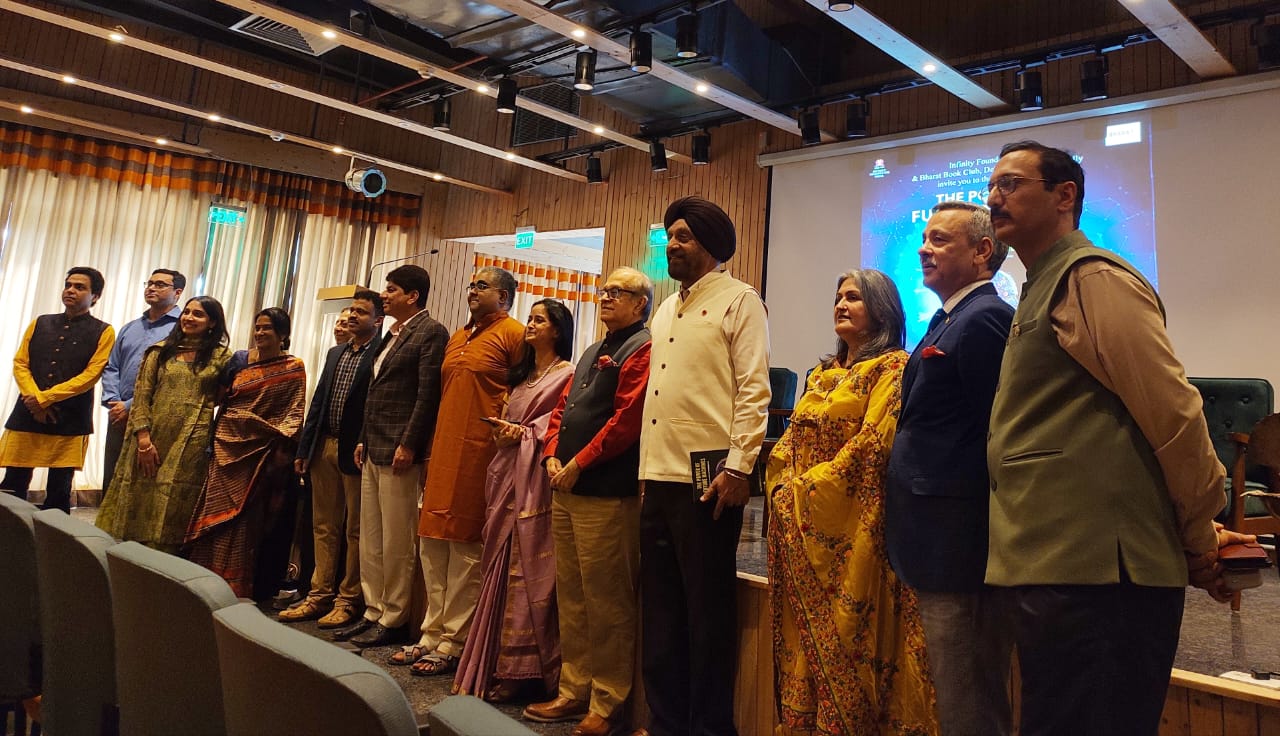
A book, ‘The Power of Future Machines’, was launched in the Hindu College’s Sushila Devi Auditorium in Delhi on Tuesday by Infinity Foundation of India and Bharat Book Club.

At the event, the co-editors of the book, Rajiv Malhotra, TN Sudarshan, and Manogna Sastry were present along with guests and several authors including Lt Gen PJS Pannu, Major General (Retd) Lav Bikram Chand, Raj Kumar Sharma, as well as Col Manik Anand, PO (AS), Ministry of Defence.

The book includes nine chapters with topics like “The Winner of the Fourth Industrial Revolution Takes It All: India’s Role in the Battle for World Dominion”,  “The Impact of AI on Freedom of Speech: Examining the Problem of Bias in Content Moderation”, “Artificial Intelligence for National Security” and “AI-MING for a Theory of Everything.”

THE BOOK

It is a collection of expert essays that talks about the future impact of Artificial Intelligence (Al) in various fields. The experts engage and discuss the potential effects of Al in this book while sharing their unique perspectives with the readers.

The Power of Future Machines. (Image: rajivmalhotra.com)
Additionally, the essays talk about how Al will influence policymaking, both in specific fields of expertise and its impact on mankind as a whole.

Sastry, who is currently the Team Leader, Research, at Infinity Foundation India, told News18 that it took more than 2 years to complete this book, which is now available on Amazon. Meanwhile, Sudarshan, who is a computer scientist and specialised in AI, as well as related technologies, stated that about 100 authors, from India as well as abroad, shared their views through the essays included in the book.

On the back cover, Lt Gen PJS Pannu, PVSM, AVSM, VSM (Retd), Former Deputy Chief of Indian Integrated Defence Staff (Operations), who was present at the launch event, wrote: “Threats devoid of emotions in hu-machine (a combination of human and machine) would need careful responses and regulating mechanisms.”

“Those who do not care to adapt shall be first recipients of such intimidation … the greed for speed will encounter a pushback by nature. Humans need new definitions of … hope, compassion, and happiness to program machines of the future,” he added.

FOCUS POINTS

Authors and guests at book launch of The Power of Future Machines. (Pic/News18)

During the launch, several key guests shared their views on the usage of AI. While talking about the book, Major General (Retd) Lav Bikram Chand highlighted that if AI is not used responsibly, it can destroy any individual or even a nation. He said: “Even though it is enlightening, at the same time it is also very scary.”

Malhotra, who is a researcher and computer scientist specialising in AI, dived deep into the concerning factors of such technological advancement.

One of those concerns highlighted by the tech expert was the “Digital Caste System”.

He said: “You should stop thinking about the traditional caste system as a whole new caste system is coming which is based on new criteria of who controls the algorithms, who has privacy, who is being manipulated without even being conscious that they are being manipulated and who is being denied rights to access various things.”

According to him, only a few people at the top of some companies control these algorithms. They set the criteria of what is true and false and what type of ideology to support.

While talking about military and defence, he said that not taking the AI weaponry strategic advantage seriously can be very costly at a time when India is “10 years behind China”.

“There are a few things that are related to AI such as quantum computing which allows breaking all the security codes. So there is a race between the US and China to see who can do it for having an advantage even for a short window in which they can do a lot of mischiefs,” he highlighted.

One particular concern has been raised during this event which is the bias of AI. Malhotra specifically talked about ChatGPT being biased and when he spoke to the people behind OpenAI, they said that “your culture can help it in training to make it ok”.

While stating his argument, Malhotra said: “If you don’t train it, it will continue to have that bias, and if you train it, you are doing the free service of training their algorithm, making it smarter to know you and the more it knows you, the more it will know how to manipulate you.”

The problem according to the tech expert is that India doesn’t have its own platforms such as an operating system, language model, search engine, and social media. So these gaps actually show that while Indians are more dependent on some other companies’ services, there is a risk of compromising the data of the citizens.

“The issues are very large and complex. So to take it forward we need more people talking about the risks and we will continue doing more work highlighting these issues,” he noted.

Read More
All Articles, Articles by Rajiv, News

राजीव मल्होत्रा का कॉलम:नस्लवाद के सिद्धांत से भारत को बांटने की कोशिशें जारी

राजीव मल्होत्रा का कॉलम:नस्लवाद के सिद्धांत से भारत को बांटने की कोशिशें जारी

3 वर्ष पहले

लगभग बारह वर्ष पूर्व मैंने एफ्रो-दलित सिद्धांत का तब प्रतिकार किया था, जब वह अपनी प्रारंभिक अवस्था में ही था। इस सिद्धांत के अनुसार दलित भारत के अश्वेत (ब्लैक) हैं और गैर-दलित श्वेत (वाइट) हैं। ऐसा मानकर यह सिद्धांत दावा करता है कि भारतीय समाज की जाति-व्यवस्था नस्लवाद (रेसिज़्म) के समतुल्य है। अपनी पुस्तक ‘ब्रेकिंग इंडिया’ में मैंने अमेरिका से संचालित और आर्थिक रूप से पोषित इस एफ्रो-दलित परियोजना की कार्यप्रणाली को समझाया था।

यह परियोजना अमेरिकी नस्लवाद के सिद्धांत के उपयोग द्वारा भारत के सामाजिक मतभेदों को भड़काकर हमारे देश को विखंडित करना चाहती है। इस पर भारतीयों को प्रतिक्रिया देनी चाहिए कि दमन का इतिहास वास्तविकता में किसी अन्य निष्कर्ष की ओर संकेत करता है। जिस प्रकार श्वेत अमेरिकियों द्वारा अश्वेतों का शोषण किया गया, उसी प्रकार भारत में हिंदुओं का शोषण हजार वर्ष तक विदेशी आक्रांताओं और यूरोपियों ने उपनिवेशीकरण द्वारा किया।

हिंदुओं को हिंदू संस्कृति और इतिहास के बारे में अमेरिका के अश्वेतों को समझाकर, उनके साथ मिलकर एक समान आधारभूमि खोजनी चाहिए थी। इसाबेल विल्करसन एक प्रमुख अश्वेत विद्वान हैं। कुछ समय पूर्व उन्होंने एक पुस्तक लिखी जिसमें एफ्रो-दलित समुदाय को विश्व में उत्पीड़ित वर्गों के केंद्रबिंदु के रूप में दर्शाया। ‘कास्ट : दि ओरिजिन्स ऑफ अवर डिस्कंटेंट्स’ शीर्षक वाली यह पुस्तक घोषणा करती है कि अनेक प्रकार के नस्लवादों में कास्ट (भारतीय जाति-वर्ण व्यवस्था के अर्थ में) केवल एक प्रकार मात्र नहीं है।

कास्ट तो वह रीढ़ की हड्डी है, जिस पर सम्पूर्ण रेसिज़्म का सिद्धांत खड़ा है। उनका मानना है कि अंग्रेज कास्ट की धारणा को वैदिक ग्रंथों से सीखकर अमेरिका में ले गए और फिर उसके आधार पर उन्होंने अमेरिका में अश्वेतों के विरुद्ध रेसिज़्म का ढांचा खड़ा किया। यह पद्धति यूरोप में भी फैली, जिसके फलस्वरूप नाजियों द्वारा यहूदियों का जनसंहार (होलोकॉस्ट) हुआ।

इस प्रकार विल्करसन यह अटपटा दावा करती हैं कि विश्व में रेसिज़्म का मूल कारण भारत की जाति-व्यवस्था है। उनके द्वारा तर्क दिया जाता है कि जाति कर्म सिद्धांत के कारण अमिट रूप से हिंदू धर्म के साथ जुड़ी है। मुझे भारत के दलितों और अमेरिका के अश्वेतों से सहानुभूति है। लेकिन विल्करसन की मान्यता से मुझे यह समस्या है कि यह अमेरिकी इतिहास के चश्मे का उपयोग करके दलितों से संबंधित मुद्दों को देखने का प्रयास करती है।

भारतीय सामाजिक व्यवस्था का इतिहास बहुत जटिल है और इसे ऐसे एकांगी विश्लेषण द्वारा नहीं समझा जा सकता। यदि इस सिद्धांत की सीमा मात्र शैक्षणिक संस्थाओं तक ही होती तो भी ठीक था, किंतु विल्करसन के इस सिद्धांत को अमरीकी सोशल मीडिया में बड़ी लोक प्रसिद्धि मिली है। विल्करसन पुलित्ज़र पुरस्कार विजेता हैं और उनकी किताब न्यूयॉर्क टाइम्स की बेस्टसेलर पुस्तकों की श्रेणी में पहला स्थान प्राप्त कर चुकी है।

ओप्रा विनफ्रे ने भी उनकी पुस्तक का प्रचार किया है। यह सिद्धांत अब ब्लैक लाइव्स मैटर आंदोलन और नई वोक सोशल जस्टिस विचारधारा का केंद्रीय अंग बन चुका है। इसे एक स्वतंत्र अभिव्यक्ति या सोच के रूप में माना जा सकता था यदि दलितों से अश्वेतों और ब्राह्मणों से श्वेतों की तुलना को एक वाद-योग्य परिकल्पना के रूप में प्रस्तुत किया जाता।

किन्तु इसे एक निर्विवाद तथ्य के रूप में प्रस्तुत किया जा रहा है। परिणामस्वरूप सामाजिक न्याय आंदोलन हिंदुओं से द्वेष के आंदोलन में परिवर्तित हो चुका है। भारत को विश्व-दमन के स्रोत के रूप में दर्शाया जा रहा है। इस विचार-सरणी का प्रतिकार करना जरूरी है।

पश्चिम का सामाजिक न्याय आंदोलन हिंदुओं से द्वेष के आंदोलन में परिवर्तित हो चुका है। दलितों से अश्वेतों और ब्राह्मणों से श्वेतों की तुलना करके भारत को विश्व-दमन के स्रोत के रूप में दर्शाया जा रहा है।

(ये लेखक के अपने विचार हैं।)

Read More