News

Reform Indian education: Author Rajiv Malhotra

HYDERABAD: Indian-American author and researcher Rajiv Malhotra — raising concerns about the Indian education system, social media policies, outsourcing of human resources and appropriation of western interventions — said India was walking the path of a ‘Vishwa Chela (global follower)’, instead of ‘Vishwa Guru (global leader)’.

Malhotra, who has authored several best-selling books like ‘Breaking India: Western Interventions in Dravidian and Dalit’ and ‘Snakes in the Ganga – Breaking India 2.0’, was speaking at a media interaction in the city as part of his three-day trip.

Malhotra said that there was a downward spiral in the democracy of India as politicians were not offering serious propositions, concepts or long-term plans to people but rather, giving bombastic, hyperbolic statements to appease them and make them feel emotionally good to win votes.

“We are facing a country like China, where people are being educated about their country and its capabilities. There is a lack of proper values in the education system of the country. Even though we say we are decolonised, the government has outsourced a lot of thinking to foreign consultants and we are getting all kinds of advice, like data security rights, national education policy and so on. We are on the path of self-destruction. We can keep having slogans like Vishwa Guru but we are becoming Vishwa Chelas,” Malhotra said.

The author also questioned whether democracy was the best route for India, citing problems faced by the West in implementing democracy.

Stressing a need to transform the NCERT and UPSC curriculum, Malhotra said that Indians were tech coolies and followers, who were doing the dirty work of American multinationals like Google, Apple, and Amazon.

In response to a question by Deccan Chronicle on growing social conflicts in the country, Malhotra said, “Because people are not isolated geographically, everybody knows what everybody else is saying and doing because of social media and the opportunity of conflict is more. What is most disturbing is the fact that the use of social media to create conflicts is being controlled by people outside the country. We don’t have our own social media and it is not our people who control the narrative. What the algorithm will support and not is in external hands and these are serious matters, which is kind of remote-control management of emotions and psychology of people”.

Infinity Foundation India president Vijaya Viswanathan, former home secretary K. Padmabhaiah, former chief secretary L.V. Subramanyam and retired IPS officer K. Aravinda Rao were among those who attended the event.

Read More
News, The Battle for IITs

Renowned author and researcher Rajiv Malhotra to visit Hyderabad

Hyderabad: Rajiv Malhotra, a best-selling author and pioneer in the research on civilizations and their engagement with technology and media from historical, social sciences, humanities and mind sciences perspective will participate and address a series of interactive sessions with people from diverse walks of life for three days in the city. He offered an in-depth analysis and critical approach in a series of books like Breaking India, Being Different, The Battle for Sanskrit, Sanskrit Non-Translatable, Artificial Intelligence and the Future of Power, Indra’s Net, Academic Hinduphobia, Snakes in the Ganga, Battle for IITs- A Defence of Meritocracy written along Vijaya Viswanathan, Ten Heads of Ravana- A Critique of Hinduphobic Scholars, edited along with Divya Reddy, Varna Jati Caste- A Premier on India Social Structures, The Power of Future Machines- Essays on Artificial Intelligence, edited along with TN Sudarshan and Manogna Sastry are a few with which Rajiv has stirred ripples in the academic departments of prominent Universities like Harvard, Oxford and other world-renowned universities. According to Pragna Bharati, from March 13 to 15, Rajiv Malhotra will interact with intellectuals, influencers, academicians and social workers in the city. On the first day of his visit, Rajiv will interact with the media and entrepreneurs. On the second day, he will interact with social media influencers. He will also address an interactive session at the University of Hyderabad, where Member of Parliament Subramanian Swamy will be the guest of honour and co-panelist to the session. On the same day, he will meet the Telugu Film fraternity and attend an interactive session at the Institute of Public Enterprise, Hyderabad. On March 15, he will be addressing an interactive session with IITians at a time when Harvard University, the USA, incubated and bred academic scholarship trying to portray and demean the IITs, the top merit-driven higher technical educational institutions in India from colonial lenses. He will also address young academicians’ conclave and meet civil servants. On the concluding day of his visit on March 15, he will be presented with PragnaPuraskar.

Read More
News, The Power of Future Machines

World Book Fair 2023: Rajiv Malhotra presents his latest book ‘The Power of Future Machines’ in the presence of Kunwar Shekhar l EXCLUSIVE

World Book Fair 2023: The 31st edition of New Delhi World Book Fair (NDWBF) began from 25 February, 2023 and will culminate on 5 March 2023. The NDBWF has picked ‘Azadi Ka Amrit Mahotsav’ as its theme. Publishers from 35 counties across the world have set up over 800 stalls to showcase the best of world’s science, literature and culture.

Best-selling Indian-American author Rajiv Malhotra also presented his book ‘The Power of Future Machines’ on Saturday, 4 March at NDWBF. Kunwar Shekhar Vijendra, chancellor of Shobhit Deemed University, was also present on the occasion.

Rajeev Malhotra talks about ‘The Power of Future Machines

In a conversation with DNP India, Rajiv Malhotra opened up about his book ‘The Power of Future Machines’ which was presented at the NDWBF. The book is a sequel to author’s book titled ‘Artificial Intelligence and the Future of Power’ which was published in 2021. The book talked about the future of Artificial Intelligence (AI) and the effect it has on various domains. While it may come across as a technical read, ‘Artificial Intelligence and the Future of Power’ talked about five battle grounds for AI, including its social, political and economical implications.

‘The Power of Future Machines’ is a collection of essays by experts exploring the future impact of Artificial Intelligence (Al) in various fields of human endeavor. Experts from various fields (military, geopolitics, strategic affairs, physics, policy and others) have described how the AI and future machines would impact their respective field. “This is a book which covers broad range of topics on the effect of AI,” Mr Malhotra told us. When asked about what new does the sequel bring to the table, the scholar said, “This is a book written by not me, but other people. Other people are reflecting their views, while the previous was one was just my authorism. Experts from various domains are taking the AI in their respective domain and are writing about it.”

‘AI is the future’

Talking about the inspiration behind the book, he said, “AI is my domain and more than 50 years ago, I came to the US for my Bachelors in Computer Science and my topic was Artificial Intelligence (AI). It was very basic and rudimentary back then.”

Mr Malhotra further told that he has made a shift to history, culture and philosophy for the past several decades, but he hasn’t lost touch with machines and technology. He feels that the future of everything depends on Artificial Intelligence. So, he is brining his good old experience back for the readers for a better understanding of AI in current spectrum.

He also said that there is a need for India to spend more in the future, i.e., AI. India is only looking for short term; the government, academics and industrialists don’t invest in R&D, Mr Malhotra said. Indians are just doing jugaad, he said, adding, it is living on old glory, praying something magical will happen. “It doesn’t matter how much elections we win, how many G-20 countries visit us. The future of everything will depend on research and development,” he quipped.

Indian students in abroad

Mr Rajiv Malhotra said that Indians are being hired by foreign companies for their development, but India has failed in securing its own brains. The foreign countries are now filing patents for work done by Indians, he said. “We are just renting out our brains and it’s a stupid thing to do,” the author said.

Mr Rajiv Malhotra also talked about Indian students studying abroad. He said while Chinese students go for STEM, Indians go abroad to study ‘what’s wrong with India?’ “They are learning Indian history, culture and about minorities from western world which is a very stupid thing to do,” he said, adding, “We are giving them too much power over us and to decide who we are”.

“The study of India is being done by the west. The study of China is being done by the Chinese. That’s the difference,” he emphasised. There’s no policy from the government to guide the students, he further added.

Talking about his future projects, Mr Malhotra said that he has 20 books unfinished. He shared that the research work is complete on various different fields. “I have many things coming up,” Mr Rajiv said.

Read More
Book review, Book Reviews, Ten Heads Of Ravana

‘Ten Heads of Ravana’: New Book by Rajiv Malhotra & Team Takes On Eminent Left-Oriented Scholars

Ten Heads of Ravana: A Critique of Hinduphobic Scholars’ is a book authored by noted scholar Rajiv Malhotra along with Divya Reddy and boasts of a collection of essays critiquing the works of 10 most prominent Left-oriented contemporary historians and scholars of ancient India. Launched in an event organised at Delhi University, the book is also available at the World Book Fair.

In the book, a team of scholars — KS Kannan, HS Meera, Manogna Sastry, Subhodeep Mukhopadhyay, Sudarshan TN, Sharda Narayanan, Anurag Sharma, and Divya Reddy — have contributed their observations through evidence-based research which is centred on questioning the western view of ancient India.

“It took four years of work by our team of scholars who went through multiple texts and intensive research to bring to light numerous factual inaccuracies, wilful misrepresentation and deliberate distortions in the scholarship of many such intellectual heads of the modern Rāvana,” said Malhotra.

The 10 intellectuals whose works have been critiqued in the book are Romila Thapar, Irfan Habib, Shashi Tharoor, Ramachandra Guha, Sheldon Pollock, Wendy Doniger, Devdutt Pattanaik, Kancha Ilaiah, and Michael Witzel — stalwarts at the forefront of such India studies, he added.

“For long, a handful of scholars and intellectual elites, whose understanding of Bharat is disjointed from tradition and often inimical to the Dharmic way of life, have controlled India’s civilisational narrative,” he said.

The team of authors said they had invited the 10 scholars whose works they had critiqued to the event but had not got any response from them.

The book was launched along with a day-long session of discussion by the authors as panelists.

Malhotra is known for his books such as Breaking India: Western Interventions in Dravidian and Dalit Fault Lines; Being different: An Indian Challenge to Western Universalism, The Battle for Sanskrit: Is Sanskrit Political or Sacred, Oppressive or Liberating, Dead or Alive?; Artificial Intelligence and the Future of Power: 5 Battlegrounds, among others.

Asked what inspired him to write on the subject, Malhotra said he has been working around countering the western view of ancient India for years and this is just another crucial subject that he wanted to address.

“Rāvaṇa was a scholar par-excellence, but he was on the wrong side of Dharma. Hence, Śrīrāma waged a war against him to prevent a breakdown of society. Similarly, today’s eminent scholars we have chosen for this anthology can be thought of as the contemporary embodiments of the historical Rāvaṇa —academically influential personalities, but grossly mischaracterising the Dharmic way of life and history of India,” said Reddy. ​

Read More
News, The Power of Future Machines

Tech Specialists Talk about New Book ‘The Power of Future Machines’, Highlight Critical AI Issues

A book, ‘The Power of Future Machines’, was launched in the Hindu College’s Sushila Devi Auditorium in Delhi on Tuesday by Infinity Foundation of India and Bharat Book Club.

At the event, the co-editors of the book, Rajiv Malhotra, TN Sudarshan, and Manogna Sastry were present along with guests and several authors including Lt Gen PJS Pannu, Major General (Retd) Lav Bikram Chand, Raj Kumar Sharma, as well as Col Manik Anand, PO (AS), Ministry of Defence.

The book includes nine chapters with topics like “The Winner of the Fourth Industrial Revolution Takes It All: India’s Role in the Battle for World Dominion”,  “The Impact of AI on Freedom of Speech: Examining the Problem of Bias in Content Moderation”, “Artificial Intelligence for National Security” and “AI-MING for a Theory of Everything.”

THE BOOK

It is a collection of expert essays that talks about the future impact of Artificial Intelligence (Al) in various fields. The experts engage and discuss the potential effects of Al in this book while sharing their unique perspectives with the readers.

The Power of Future Machines. (Image: rajivmalhotra.com)
Additionally, the essays talk about how Al will influence policymaking, both in specific fields of expertise and its impact on mankind as a whole.

Sastry, who is currently the Team Leader, Research, at Infinity Foundation India, told News18 that it took more than 2 years to complete this book, which is now available on Amazon. Meanwhile, Sudarshan, who is a computer scientist and specialised in AI, as well as related technologies, stated that about 100 authors, from India as well as abroad, shared their views through the essays included in the book.

On the back cover, Lt Gen PJS Pannu, PVSM, AVSM, VSM (Retd), Former Deputy Chief of Indian Integrated Defence Staff (Operations), who was present at the launch event, wrote: “Threats devoid of emotions in hu-machine (a combination of human and machine) would need careful responses and regulating mechanisms.”

“Those who do not care to adapt shall be first recipients of such intimidation … the greed for speed will encounter a pushback by nature. Humans need new definitions of … hope, compassion, and happiness to program machines of the future,” he added.

FOCUS POINTS

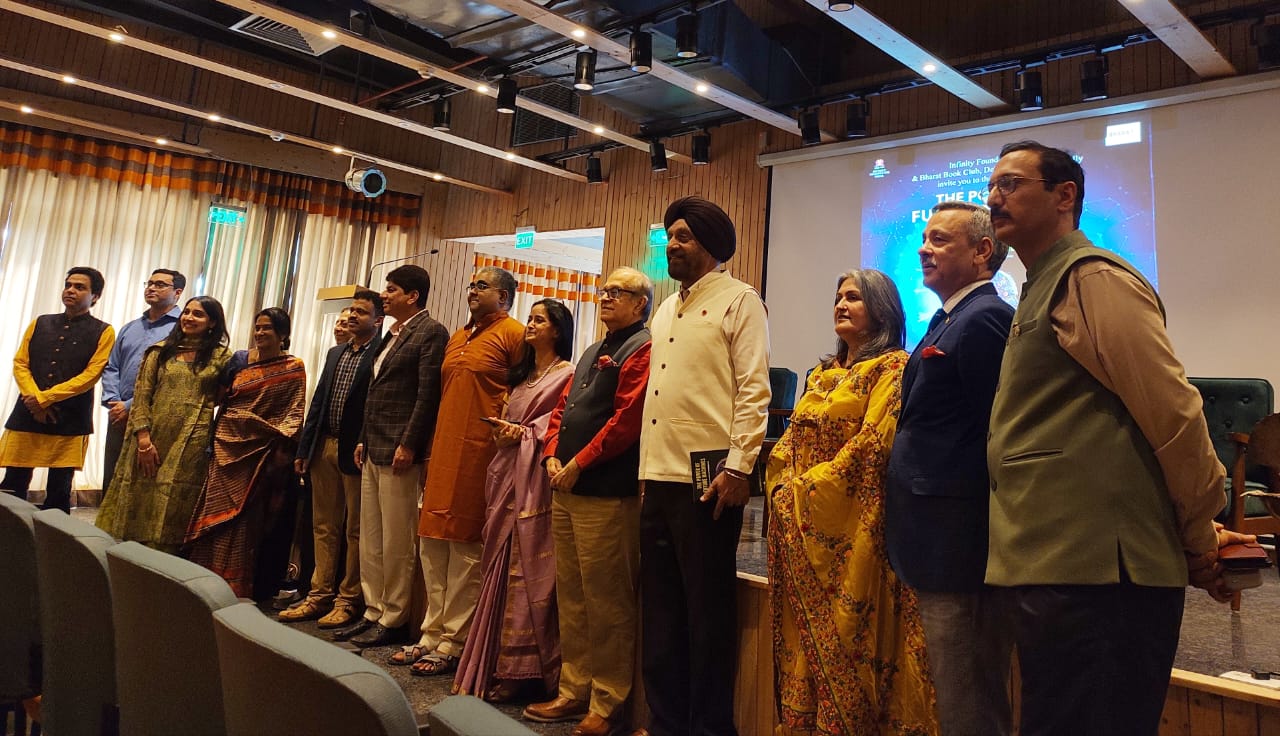
Authors and guests at book launch of The Power of Future Machines. (Pic/News18)

During the launch, several key guests shared their views on the usage of AI. While talking about the book, Major General (Retd) Lav Bikram Chand highlighted that if AI is not used responsibly, it can destroy any individual or even a nation. He said: “Even though it is enlightening, at the same time it is also very scary.”

Malhotra, who is a researcher and computer scientist specialising in AI, dived deep into the concerning factors of such technological advancement.

One of those concerns highlighted by the tech expert was the “Digital Caste System”.

He said: “You should stop thinking about the traditional caste system as a whole new caste system is coming which is based on new criteria of who controls the algorithms, who has privacy, who is being manipulated without even being conscious that they are being manipulated and who is being denied rights to access various things.”

According to him, only a few people at the top of some companies control these algorithms. They set the criteria of what is true and false and what type of ideology to support.

While talking about military and defence, he said that not taking the AI weaponry strategic advantage seriously can be very costly at a time when India is “10 years behind China”.

“There are a few things that are related to AI such as quantum computing which allows breaking all the security codes. So there is a race between the US and China to see who can do it for having an advantage even for a short window in which they can do a lot of mischiefs,” he highlighted.

One particular concern has been raised during this event which is the bias of AI. Malhotra specifically talked about ChatGPT being biased and when he spoke to the people behind OpenAI, they said that “your culture can help it in training to make it ok”.

While stating his argument, Malhotra said: “If you don’t train it, it will continue to have that bias, and if you train it, you are doing the free service of training their algorithm, making it smarter to know you and the more it knows you, the more it will know how to manipulate you.”

The problem according to the tech expert is that India doesn’t have its own platforms such as an operating system, language model, search engine, and social media. So these gaps actually show that while Indians are more dependent on some other companies’ services, there is a risk of compromising the data of the citizens.

“The issues are very large and complex. So to take it forward we need more people talking about the risks and we will continue doing more work highlighting these issues,” he noted.

Read More
All Articles, Articles by Rajiv, News

राजीव मल्होत्रा का कॉलम:नस्लवाद के सिद्धांत से भारत को बांटने की कोशिशें जारी

राजीव मल्होत्रा का कॉलम:नस्लवाद के सिद्धांत से भारत को बांटने की कोशिशें जारी

3 वर्ष पहले

लगभग बारह वर्ष पूर्व मैंने एफ्रो-दलित सिद्धांत का तब प्रतिकार किया था, जब वह अपनी प्रारंभिक अवस्था में ही था। इस सिद्धांत के अनुसार दलित भारत के अश्वेत (ब्लैक) हैं और गैर-दलित श्वेत (वाइट) हैं। ऐसा मानकर यह सिद्धांत दावा करता है कि भारतीय समाज की जाति-व्यवस्था नस्लवाद (रेसिज़्म) के समतुल्य है। अपनी पुस्तक ‘ब्रेकिंग इंडिया’ में मैंने अमेरिका से संचालित और आर्थिक रूप से पोषित इस एफ्रो-दलित परियोजना की कार्यप्रणाली को समझाया था।

यह परियोजना अमेरिकी नस्लवाद के सिद्धांत के उपयोग द्वारा भारत के सामाजिक मतभेदों को भड़काकर हमारे देश को विखंडित करना चाहती है। इस पर भारतीयों को प्रतिक्रिया देनी चाहिए कि दमन का इतिहास वास्तविकता में किसी अन्य निष्कर्ष की ओर संकेत करता है। जिस प्रकार श्वेत अमेरिकियों द्वारा अश्वेतों का शोषण किया गया, उसी प्रकार भारत में हिंदुओं का शोषण हजार वर्ष तक विदेशी आक्रांताओं और यूरोपियों ने उपनिवेशीकरण द्वारा किया।

हिंदुओं को हिंदू संस्कृति और इतिहास के बारे में अमेरिका के अश्वेतों को समझाकर, उनके साथ मिलकर एक समान आधारभूमि खोजनी चाहिए थी। इसाबेल विल्करसन एक प्रमुख अश्वेत विद्वान हैं। कुछ समय पूर्व उन्होंने एक पुस्तक लिखी जिसमें एफ्रो-दलित समुदाय को विश्व में उत्पीड़ित वर्गों के केंद्रबिंदु के रूप में दर्शाया। ‘कास्ट : दि ओरिजिन्स ऑफ अवर डिस्कंटेंट्स’ शीर्षक वाली यह पुस्तक घोषणा करती है कि अनेक प्रकार के नस्लवादों में कास्ट (भारतीय जाति-वर्ण व्यवस्था के अर्थ में) केवल एक प्रकार मात्र नहीं है।

कास्ट तो वह रीढ़ की हड्डी है, जिस पर सम्पूर्ण रेसिज़्म का सिद्धांत खड़ा है। उनका मानना है कि अंग्रेज कास्ट की धारणा को वैदिक ग्रंथों से सीखकर अमेरिका में ले गए और फिर उसके आधार पर उन्होंने अमेरिका में अश्वेतों के विरुद्ध रेसिज़्म का ढांचा खड़ा किया। यह पद्धति यूरोप में भी फैली, जिसके फलस्वरूप नाजियों द्वारा यहूदियों का जनसंहार (होलोकॉस्ट) हुआ।

इस प्रकार विल्करसन यह अटपटा दावा करती हैं कि विश्व में रेसिज़्म का मूल कारण भारत की जाति-व्यवस्था है। उनके द्वारा तर्क दिया जाता है कि जाति कर्म सिद्धांत के कारण अमिट रूप से हिंदू धर्म के साथ जुड़ी है। मुझे भारत के दलितों और अमेरिका के अश्वेतों से सहानुभूति है। लेकिन विल्करसन की मान्यता से मुझे यह समस्या है कि यह अमेरिकी इतिहास के चश्मे का उपयोग करके दलितों से संबंधित मुद्दों को देखने का प्रयास करती है।

भारतीय सामाजिक व्यवस्था का इतिहास बहुत जटिल है और इसे ऐसे एकांगी विश्लेषण द्वारा नहीं समझा जा सकता। यदि इस सिद्धांत की सीमा मात्र शैक्षणिक संस्थाओं तक ही होती तो भी ठीक था, किंतु विल्करसन के इस सिद्धांत को अमरीकी सोशल मीडिया में बड़ी लोक प्रसिद्धि मिली है। विल्करसन पुलित्ज़र पुरस्कार विजेता हैं और उनकी किताब न्यूयॉर्क टाइम्स की बेस्टसेलर पुस्तकों की श्रेणी में पहला स्थान प्राप्त कर चुकी है।

ओप्रा विनफ्रे ने भी उनकी पुस्तक का प्रचार किया है। यह सिद्धांत अब ब्लैक लाइव्स मैटर आंदोलन और नई वोक सोशल जस्टिस विचारधारा का केंद्रीय अंग बन चुका है। इसे एक स्वतंत्र अभिव्यक्ति या सोच के रूप में माना जा सकता था यदि दलितों से अश्वेतों और ब्राह्मणों से श्वेतों की तुलना को एक वाद-योग्य परिकल्पना के रूप में प्रस्तुत किया जाता।

किन्तु इसे एक निर्विवाद तथ्य के रूप में प्रस्तुत किया जा रहा है। परिणामस्वरूप सामाजिक न्याय आंदोलन हिंदुओं से द्वेष के आंदोलन में परिवर्तित हो चुका है। भारत को विश्व-दमन के स्रोत के रूप में दर्शाया जा रहा है। इस विचार-सरणी का प्रतिकार करना जरूरी है।

पश्चिम का सामाजिक न्याय आंदोलन हिंदुओं से द्वेष के आंदोलन में परिवर्तित हो चुका है। दलितों से अश्वेतों और ब्राह्मणों से श्वेतों की तुलना करके भारत को विश्व-दमन के स्रोत के रूप में दर्शाया जा रहा है।

(ये लेखक के अपने विचार हैं।)

Read More
All Articles, Articles by Rajiv

How new Ambedkarites are busy undermining Ambedkar and his legacy

How new Ambedkarites are busy undermining Ambedkar and his legacy

New Ambedkarites’ alignment with the new American camp of Wokeism makes them an ally of global Islam and evangelical Christianity — both of which BR Ambedkar vehemently opposed

How new Ambedkarites are busy undermining Ambedkar and his legacy

It is well known that BR Ambedkar turned to Buddhism for the upliftment of Dalits. But what is not widely understood is that he changed Buddhism in fundamental ways — away from its spiritual focus and towards a social-political focus.

To achieve this, he did away with karma theory and meditation practice, both of which are integral to the teachings of Buddha. This enabled him to differentiate it from Hinduism. He wanted to reject Hinduism because of Mohandas Gandhi’s position on caste.

But his rejection of Christianity and Islam was even more emphatic. Ambedkar was uncompromising in insisting that Indians should not adopt either Christianity or Islam because these religions were alien to the ethos and core values of Indians. He feared that they would create conflicts and cause divisions among Indians. Ambedkar also explicitly rejected communism.

Another remarkable quality in his uncompromising patriotism was that he left the US and UK after his higher education there and returned to India to pursue his nation-building ambitions. He did not like the idea of championing his reformist ideas from American or British soil or in alignment with any of their institutions.

Unfortunately, Ambedkar didn’t live long enough to fully implement his modified version of Buddhism and be able to demonstrate that this new religion would succeed in uplifting his followers. After his death, his followers lacked the creativity and leadership to advance his pioneering ideas further.

This vacuum of creative leadership has been filled by Harvard University’s poster boy, Suraj Yengde, who has proclaimed himself as Ambedkar’s successor. Yengde assumes that it is his destiny to step into Ambedkar’s shoes and complete the social transformation Ambedkar had started.

However, using his Harvard perch and alliance with Black Americans and the Woke movement, Yengde has positioned himself in ways that betray Ambedkar’s patriotism. Without support from the Harvard power nexus, he could not have become so prominent considering that he openly propagates falsehoods and frequently contradicts himself without remorse or inhibition.

Yengde is on a warpath with Hinduism, and more broadly with Indian social and cultural values, in ways that compromise India’s integrity and sovereignty. As our recent book Snakes in the Ganga has documented, Yengde calls Shankaracharya, a legendary intellectual leader of Hinduism, an “ugly head dumpster”; and he accuses him of “killing many monks”. He says that there was an “onslaught and attacks to eliminate Buddha from this land”. According to him, Hindus desecrated Buddhist temples and viharas, and “the monks were killed en masse by the invading kingdoms of the so-called invading Brahminic order”.

Without citing any shred of evidence, Yengde has said: “When the Buddha came on to the consciousness of India, he became the biggest threat to the Vedic caste system because Buddha just crumbled the house of cards of caste system. Because Buddha offered that many tribes, which were eventually declared untouchables, become part of Dhamma and because they were part of dhamma, there was a repeated assassination of the people who were identifying themselves in the pathway of dhamma. Buddha himself was subjected to several attacks, physical, spiritual.”

Yengde’s vitriolic hatred for Brahmins leads him to want to dismantle Hinduism. What he ignores is that Indian traditions, Hindu and Buddhist alike, have thrived on open and honest debates among experts. There was never any form of what is today being practiced as cancel culture. Indians of all persuasions have prided themselves by engaging in logical arguments instead of being fixated on dogma or political rivalry. The cancel culture championed at Harvard today is antithetical to the path of the Buddha and inconsistent with Ambedkar’s ideology.

Yengde’s alignment with the new American camp of Wokeism makes him an ally of global Islam and evangelical Christianity both of which Ambedkar vehemently opposed. His membership in Harvard’s elitism, and his participation in the Breaking India nexus in the United States, should concern the genuine Buddhists in India. They should pause before letting him infiltrate further and hijack one of India’s great spiritual traditions and gifts to the world.

Written by Rajiv Malhotra

Read More
All Articles, Articles by Rajiv

Rajeev Malhotra column Efforts continue divide India principle racism _ राजीव मल्होत्रा का कॉलम_ नस्लवाद के सिद्धांत से भारत को बांटने की कोशिशें जारी –

लगभग बारह वर्ष पूर्व मैंने एफ्रो -दलि त सि द्धां त का तब प्रति का र कि या था, जब वह अपनी प्रा रंभि क अवस्था में ही था । इस सि द्धां त के अनुसा र दलि त भा रत के अश्वेत
(ब्लैक) हैं और गैर-दलि त श्वेत (वा इट) हैं। ऐसा मा नकर यह सि द्धां त दा वा करता है कि भा रती य समा ज की जा ति -व्यवस्था नस्लवा द (रेसि ज़्म) के समतुल्य है। अपनी
पुस्तक ‘ब्रेकिं ग इंडि या ’ में मैंने अमेरि का से संचा लि त और आर्थि क रूप सेपो षि त इस एफ्रो -दलि त परि यो जना की का र्यप्रणा ली को समझा या था ।

यह परि यो जना अमेरि की नस्लवा द के सि द्धां त के उपयो ग द्वा रा भा रत के सामा जि क मतभेदों को भड़का कर हमा रेदेश को वि खंडि त करना चा हती है। इस पर भा रती यों
को प्रति क्रि या देनी चा हि ए कि दमन का इति हा स वा स्तवि कता में कि सी अन्य नि ष्कर्ष की ओर संकेत करता है। जि स प्रका र श्वेत अमेरि कि यों द्वा रा अश्वेतों का शो षण
कि या गया , उसी प्रका र भा रत में हिं दुओं का शो षण हजा र वर्ष तक वि देशी आक्रां ता ओं और यूरोपि यों ने उपनि वेशी करण द्वा रा कि या ।
हिं दुओं को हिं दू संस्कृति और इति हा स के बा रेमें अमेरि का के अश्वेतों को समझा कर, उनके सा थ मि लकर एक समा न आधा रभूमि खोजनी चा हि ए थी । इसा बेल
वि ल्करसन एक प्रमुख अश्वेत वि द्वा न हैं। कुछ समय पूर्व उन्हों ने एक पुस्तक लि खी जि समें एफ्रो -दलि त समुदा य को वि श्व में उत्पी ड़ि त वर्गों के केंद्रबिं दु के रूप में दर्शा या ।
‘का स्ट : दि ओरि जि न्स ऑफ अवर डि स्कंटेंट्स’ शी र्षक वा ली यह पुस्तक घो षणा करती है कि अनेक प्रका र के नस्लवा दों में का स्ट (भा रती य जा ति -वर्ण व्यवस्था के अर्थ
में) केवल एक प्रका र मा त्र नहीं है।

कास्ट तो वह रीढ़ की हड्डी है, जि स पर सम्पूर्ण रेसि ज़्म का सि द्धां त खड़ा है। उनका मा नना है कि अंग्रेज का स्ट की धा रणा को वैदि क ग्रंथों से सी खकर अमेरि का में ले
गए और फि र उसके आधा र पर उन्हों ने अमेरि का में अश्वेतों के वि रुद्ध रेसि ज़्म का ढां चा खड़ा कि या । यह पद्धति यूरोप में भी फैली , जि सके फलस्वरूप ना जि यों द्वा रा
यहूदि यों का जनसंहार (हो लो कॉ स्ट) हुआ।
इस प्रका र वि ल्करसन यह अटपटा दा वा करती हैं कि वि श्व में रेसि ज़्म का मूल का रण भा रत की जा ति -व्यवस्था है। उनके द्वा रा तर्क दि या जा ता है कि जा ति कर्म सि द्धां त
के का रण अमि ट रूप सेहिं दू धर्म के साथ जुड़ी है। मुझे भा रत के दलि तों और अमेरि का के अश्वेतों से सहा नुभूति है। लेकि न वि ल्करसन की मा न्यता से मुझे यह समस्या
है कि यह अमेरि की इति हा स के चश्मे का उपयो ग करके दलि तों सेसंबंधि त मुद्दों को देखने का प्रया स करती है।
भा रती य सामा जि क व्यवस्था का इति हा स बहुत जटि ल है और इसेऐसेएकां गी वि श्लेषण द्वा रा नहीं समझा जा सकता । यदि इस सि द्धां त की सी मा मा त्र शैक्षणि क
संस्था ओं तक ही हो ती तो भी ठी क था, किं तु वि ल्करसन के इस सि द्धां त को अमरीकी सो शल मी डि या में बड़ी लो क प्रसि द्धि मि ली है। वि ल्करसन पुलि त्ज़र पुरस्का र
वि जेता हैं और उनकी कि ता ब न्यूयॉ र्क टा इम्स की बेस्टसेलर पुस्तकों की श्रेणी में पहला स्था न प्रा प्त कर चुकी है।
ओप्रा वि नफ्रे ने भी उनकी पुस्तक का प्रचा र कि या है। यह सि द्धां त अब ब्लैक ला इव्स मैटर आंदो लन और नई वो क सो शल जस्टि स वि चा रधा रा का केंद्री य अंग बन चुका
है। इसेएक स्वतंत्र अभि व्यक्ति या सोच के रूप में मा ना जा सकता था यदि दलि तों से अश्वेतों और ब्रा ह्मणों से श्वेतों की तुलना को एक वा द-यो ग्य परि कल्पना के रूप में
प्रस्तुत कि या जा ता ।
कि न्तु इसेएक नि र्वि वा द तथ्य के रूप में प्रस्तुत कि या जा रहा है। परि णा मस्वरूप सामा जि क न्या य आंदो लन हिं दुओं से द्वेष के आंदो लन में परि वर्ति त हो चुका है। भा रत
को वि श्व-दमन के स्रो त के रूप में दर्शा या जा रहा है। इस वि चा र-सरणी का प्रति का र करना जरूरी है।

पश्चि म का सामा जि क न्या य आंदो लन हिं दुओं सेद्वेष के आंदो लन में परि वर्ति त हो चुका है। दलि तों से अश्वेतों और ब्रा ह्मणों से श्वेतों की तुलना करके भा रत को वि श्व-
दमन के स्रो त के रूप में दर्शा या जा रहा है।

(ये लेखक के अपने वि चा र हैं।)

Read More
All Articles, Articles by Rajiv, News

Opinion | Why India’s IITs Are Being Targeted In West For Pushing Meritocracy

Opinion | Why India’s IITs Are Being Targeted In West For Pushing Meritocracy

Harvard University professor Ajantha Subramanian has accused the IITs of perpetuating caste oppression

In her influential book The Caste of Merit: Engineering Education in India, Harvard University’s professor Ajantha Subramanian has accused the IITs of perpetuating caste oppression. The crux of her argument is that the structure of IITs favours Brahmins and upper castes and is oppressive towards the lower castes. Therefore, even if entrance examinations are open to all and there is no discrimination in how marks are awarded, they are still guilty.

She traces the oppressive structure to the period of British rule in India. Prior to that, engineering was considered a hands-on job that was suitable for lower caste people. This changed during the British period because they split the discipline into its theoretical and hands-on aspects. With Brahmins conspiring to grab the theoretical side, only the hands-on work remained for lower castes. Since Brahmins were intelligent people, this kind of stratification also served the British interest, because they could use their skills in administration. It also opened the door for Brahmins to make money as technocrats and industrialists, which was not possible in their traditional roles. Therefore, the whole arrangement was highly beneficial for Brahmins while it hurt lower castes.

This part of her thesis is substantially correct. Infinity Foundation has documented the skills of many lower caste people in its History of Indian Science and Technology book series. What Subramanian fails to uncover however is the lack of initiatives by the Indian government since independence to take corrective measures. The British system was not designed to skill the lower castes but was intended to develop a battery of clerks that would help them rule the country.

Rather than bringing a change in the education system invented by the British, successive governments have continued with it. This has resulted in a loss of skill at the hands-on level because getting an education does not help people get jobs at that level. It also does not attract people who may have an aptitude for such work simply because it doesn’t pay. On the other hand, the expansion of engineering into computer sciences has further expanded the theoretical side, creating additional opportunities for the people engaged in theory. Therefore, the flow of human capital based on skills and aptitude is blocked.

Subramanian’s contention is that the only way to correct this unfortunate circumstance is by dismantling the IITs. It doesn’t matter that these centres of excellence produce the most talented tech people that the world recognises. It also doesn’t matter to her that these institutions are lifting the value of Brand India all over the world. She cannot tolerate the success of IIT people either in India or in Silicon Valley, or the way that they are spreading their influence all over the world through their professional networking. According to her, this spread of influence is pernicious because it is an expansion of Brahmin power.

Her theory assumes that lower caste people lack merit, because of which they cannot pass the entrance exam and qualify as IIT engineers. Therefore, she declares the entrance exam itself to be a sham. It is not based on true meritocracy because it excludes certain people. She does not support changing the system to treat equally the hands-on and theoretical students, even though that would remedy her claim of bias. Nothing less than rejecting meritocracy would satisfy her.

Subramanian’s problem with the IITs and her solution is linked to the Marxist ideology that she prescribes to. Since Marxism requires you to dismantle existing structures to make way for a new one and since IITs are well-established structures, she is calling for their destruction.

Details of her thesis and our rebuttal are in the book, Snakes in the Ganga. Visit SnakesInTheGanga.com.

Read More
All Articles, Articles by Rajiv

Do IITs favour Brahmins and perpetuate caste oppression?

Do IITs favour Brahmins and perpetuate caste oppression?

Harvard University professor Ajantha Subramanian has accused the IITs of perpetuating caste oppression

In her influential book The Caste of Merit: Engineering Education in India, Harvard University’s professor Ajantha Subramanian has accused the IITs of perpetuating caste oppression. The crux of her argument is that the structure of IITs favours Brahmins and upper castes and is oppressive towards the lower castes. Therefore, even if entrance examinations are open to all and there is no discrimination in how marks are awarded, they are still guilty.

She traces the oppressive structure to the period of British rule in India. Prior to that, engineering was considered a hands-on job that was suitable for lower caste people. This changed during the British period because they split the discipline into its theoretical and hands-on aspects. With Brahmins conspiring to grab the theoretical side, only the hands-on work remained for lower castes. Since Brahmins were intelligent people, this kind of stratification also served the British interest, because they could use their skills in administration. It also opened the door for Brahmins to make money as technocrats and industrialists, which was not possible in their traditional roles. Therefore, the whole arrangement was highly beneficial for Brahmins while it hurt lower castes.

This part of her thesis is substantially correct. Infinity Foundation has documented the skills of many lower caste people in its History of Indian Science and Technology book series. What Subramanian fails to uncover however is the lack of initiatives by the Indian government since independence to take corrective measures. The British system was not designed to skill the lower castes but was intended to develop a battery of clerks that would help them rule the country.

Rather than bringing a change in the education system invented by the British, successive governments have continued with it. This has resulted in a loss of skill at the hands-on level because getting an education does not help people get jobs at that level. It also does not attract people who may have an aptitude for such work simply because it doesn’t pay. On the other hand, the expansion of engineering into computer sciences has further expanded the theoretical side, creating additional opportunities for the people engaged in theory. Therefore, the flow of human capital based on skills and aptitude is blocked.

Subramanian’s contention is that the only way to correct this unfortunate circumstance is by dismantling the IITs. It doesn’t matter that these centres of excellence produce the most talented tech people that the world recognises. It also doesn’t matter to her that these institutions are lifting the value of Brand India all over the world. She cannot tolerate the success of IIT people either in India or in Silicon Valley, or the way that they are spreading their influence all over the world through their professional networking. According to her, this spread of influence is pernicious because it is an expansion of Brahmin power.

Her theory assumes that lower caste people lack merit, because of which they cannot pass the entrance exam and qualify as IIT engineers. Therefore, she declares the entrance exam itself to be a sham. It is not based on true meritocracy because it excludes certain people. She does not support changing the system to treat equally the hands-on and theoretical students, even though that would remedy her claim of bias. Nothing less than rejecting meritocracy would satisfy her.

Subramanian’s problem with the IITs and her solution are linked to the Marxist ideology that she prescribes to. Since Marxism requires you to dismantle existing structures to make way for a new one and since IITs are well-established structures, she is calling for their destruction.

Details of her thesis and our rebuttal are in the book, Snakes in the Ganga. Visit: rajivmalhotra.com.

Read More