News

Cover Story in Swarajya Magazine

RAJIV MALHOTRA, author and Hindu
intellectual, is the man who developed
the “Breaking India” theory in his
eponymous 2011 book. Malhotra has
written prolifically in opposition to the
academic study of Indian history and
society, especially Hinduism, as it is
conducted by scholars and university
faculty of the West, which, he maintains,
undermines the interests of India “by
encouraging the paradigms that oppose
its unity and integrity”. In an interview
with R Jagannathan, he speaks about
the dangers that Indian and Hindu
nationhood face today. Excerpts:

Read More
News

Time for Indians to act, decolonize, reclaim their civilizational sense

Hyderabad: How India and Indians should decolonise, take control and reclaim their sense of civilisation? Addressing a range of issues at a joint media conference here on Monday, the founder of Infinity Foundation and prominent authors Rajiv Malhotra and Prof Vijaya Viswanathan answered, covering a range of issues the country has been facing on multiple fronts. Malhotra said unlike earlier the current generation is being driven by social media where one has to make their point in two seconds. “Our civilisation is based on elements which require a lot of concentration, and a lot of attention span, there would be discussions and debates for days. However, there is a degradation of the mind, quality of thinking has gone down these days. When you have such people in a democracy you have to cater to such people to get elected. So politicians’ thinking turn low-level. They offer an emotional idea here and there which is simple and everybody can understand. This is the problem of downward spiral of democracy for appeasement of people. This requires them to pick a short-term, quick sensational issues. Since people fall in such a trap they continue to demand more of the same. He said China has educated three generations of people over the past 50 years. They may not know English, but they are more critical and come up dwelling deep into issues and come up with intelligent answers. Whereas, “Our people engage more in the useless talk with randomly give answers,” he added. He found fault with the education system and lack of proper values in the NCERT and UPSC examinations. Though the country claims to be politically free it is depending on foreign consultants for all kinds of advice telling us about data security, human rights, National Education Policy. We have opened up for others to come and take over the space, he added. He called for allowing foreign universities to set up their campuses without any regulations vis a vis their Indian counterparts, will be nothing more than self-destruction 2.0, if not handled properly, he said. Malhotra stated that emotional slogans like Viswa Guru and VasudaivaKutumbakam are not sustainable when the country is failing to produce thinking people and competitive people needed today.. Prof Viswanathan said the government and parents are failing to do due diligence while inviting foreign consultants as well as sending their children for overseas education. She cited how Singapore has scrapped its tie-up with prominent Yale University, as that country feels liberal arts and social sciences of the university are divisive and not in interest of the country. She said most undergraduate students after studying four years of liberal arts even in prestigious universities like Harvard remain jobless. Bringing such subject areas, into Indian universities would result in unskilling youth and “We end up paying to bring up our children to become activists by studying such western-oriented liberal arts.” Responding to a question, Malhotra said either the government or the gurus who wield lot of authority and have followers and are not short of funds, should ignite fire among people to think about the nation. He said the BJP and RSS, as well as organising sakhas could not produce intellectual kshatriyas to lead India. On the other hand the Left has deeply entrenched the academic and intellectual areas. Even after eight years, the current government could not change the syllabi of NCERT and UPSC. Now things are moving at a faster pace at global scale. However, Indian investment in the R&D remains lowest in the world which makes it lag behind in technology. Supplying IT coolies and following others does not mean owning technology. China provides labour and outsmarts its own clients by learning technology from the US, but also going ahead of that country, he pointed out.

Read More
News, Snakes in the ganga

Need to focus on education & Indian values

HYDERABAD: Rajiv Malhotra, author, researcher and founder of Infinity Foundation, USA is on a three-day long visit to Hyderabad. As part of his visit, he interacted with mediapersons on issues such as “western influences on Indian academia”, “divisive narratives from within and outside the country” and “threat to Indian value system”. The interaction was organised by Pragna Bharati, Telangana, an independent forum of intellectuals that holds talks and seminars by prominent leaders.

Among other guests presiding over the event, were K. Aravinda Rao, former DGP, Andhra Pradesh (united cadre) who is also a writer and a translator; and Vijaya Viswanathan, President, Infinity Foundation and co-author of “Varna, Jati, Caste”.

Introducing Malhotra to media persons, Aravinda Rao said, “Rajiv Malhotra is admired across the country. His fresh insights impinge on how polity functions. He has opened our eyes to the developments taking place outside the country. Despite our own differences, we, as a nation, want to remain together. However, some dialogues that have developed overseas, have begun to dominate our narrative within the country. Rajiv Malhotra’s knowledge has enabled thinkers, political analysts, to understand the ramifications of some of these ideas. The question before us is, how do we tackle this “nuisance” and to ensure that the country’s “unity” is not broken.”

Interacting with media persons, Malhotra talked about the “ignorance of the Indian masses and how to bring them back on track”. “In spite of 30 years of work, there are a few, nowadays, who are interested in doing hard work. There is a degradation of quality of mind, the level of thinking among the masses has gone down. In a democracy, however, you have to cater to such people in order to get elected. Politicians have to become emotional, which leads to appeasement politics,” Malhotra said.

“We have a third generation of educated people who cannot think for themselves. They may have foreign degrees from reputed universities but they are not able to answer my questions. They are not able to think clearly. I am thinking of bigger things such as lack of proper education, lack of a valid value system. Our problem is that once the politicians get elected, they invite foreign advisors to guide us on our education system, data rights, etc,” he said.

“Now the government is going to allow foreign universities to set up campuses in India with no restrictions. Indian universities have restrictions but foreign ones do not. We are proudly becoming ‘vishwa-chelas’ instead of ‘vishwa-guru’,” he added.

Emphasising on the content taught in foreign universities, Dr Vijaya Viswanathan added that there are courses being taught in foreign universities. “The government doesn’t do due diligence to see who they are bringing to India, who they are working for. They are just doing a consulting assignment to make money for their parent company, they have no interest in India,” she said.

Adding, she said that countries like Russia and Singapore value their civilisational ethos. They value their education system. “For example, after ten years of collaboration Singapore university separated ways from Yale university saying that their liberal arts have made our society very divisive,” she said. Dr Rajiv Malhotra will be visiting Hyderabad Central University (HCU) on Tuesday to interact with students

Read More
News

Reform Indian education: Author Rajiv Malhotra

HYDERABAD: Indian-American author and researcher Rajiv Malhotra — raising concerns about the Indian education system, social media policies, outsourcing of human resources and appropriation of western interventions — said India was walking the path of a ‘Vishwa Chela (global follower)’, instead of ‘Vishwa Guru (global leader)’.

Malhotra, who has authored several best-selling books like ‘Breaking India: Western Interventions in Dravidian and Dalit’ and ‘Snakes in the Ganga – Breaking India 2.0’, was speaking at a media interaction in the city as part of his three-day trip.

Malhotra said that there was a downward spiral in the democracy of India as politicians were not offering serious propositions, concepts or long-term plans to people but rather, giving bombastic, hyperbolic statements to appease them and make them feel emotionally good to win votes.

“We are facing a country like China, where people are being educated about their country and its capabilities. There is a lack of proper values in the education system of the country. Even though we say we are decolonised, the government has outsourced a lot of thinking to foreign consultants and we are getting all kinds of advice, like data security rights, national education policy and so on. We are on the path of self-destruction. We can keep having slogans like Vishwa Guru but we are becoming Vishwa Chelas,” Malhotra said.

The author also questioned whether democracy was the best route for India, citing problems faced by the West in implementing democracy.

Stressing a need to transform the NCERT and UPSC curriculum, Malhotra said that Indians were tech coolies and followers, who were doing the dirty work of American multinationals like Google, Apple, and Amazon.

In response to a question by Deccan Chronicle on growing social conflicts in the country, Malhotra said, “Because people are not isolated geographically, everybody knows what everybody else is saying and doing because of social media and the opportunity of conflict is more. What is most disturbing is the fact that the use of social media to create conflicts is being controlled by people outside the country. We don’t have our own social media and it is not our people who control the narrative. What the algorithm will support and not is in external hands and these are serious matters, which is kind of remote-control management of emotions and psychology of people”.

Infinity Foundation India president Vijaya Viswanathan, former home secretary K. Padmabhaiah, former chief secretary L.V. Subramanyam and retired IPS officer K. Aravinda Rao were among those who attended the event.

Read More
News, The Battle for IITs

Renowned author and researcher Rajiv Malhotra to visit Hyderabad

Hyderabad: Rajiv Malhotra, a best-selling author and pioneer in the research on civilizations and their engagement with technology and media from historical, social sciences, humanities and mind sciences perspective will participate and address a series of interactive sessions with people from diverse walks of life for three days in the city. He offered an in-depth analysis and critical approach in a series of books like Breaking India, Being Different, The Battle for Sanskrit, Sanskrit Non-Translatable, Artificial Intelligence and the Future of Power, Indra’s Net, Academic Hinduphobia, Snakes in the Ganga, Battle for IITs- A Defence of Meritocracy written along Vijaya Viswanathan, Ten Heads of Ravana- A Critique of Hinduphobic Scholars, edited along with Divya Reddy, Varna Jati Caste- A Premier on India Social Structures, The Power of Future Machines- Essays on Artificial Intelligence, edited along with TN Sudarshan and Manogna Sastry are a few with which Rajiv has stirred ripples in the academic departments of prominent Universities like Harvard, Oxford and other world-renowned universities. According to Pragna Bharati, from March 13 to 15, Rajiv Malhotra will interact with intellectuals, influencers, academicians and social workers in the city. On the first day of his visit, Rajiv will interact with the media and entrepreneurs. On the second day, he will interact with social media influencers. He will also address an interactive session at the University of Hyderabad, where Member of Parliament Subramanian Swamy will be the guest of honour and co-panelist to the session. On the same day, he will meet the Telugu Film fraternity and attend an interactive session at the Institute of Public Enterprise, Hyderabad. On March 15, he will be addressing an interactive session with IITians at a time when Harvard University, the USA, incubated and bred academic scholarship trying to portray and demean the IITs, the top merit-driven higher technical educational institutions in India from colonial lenses. He will also address young academicians’ conclave and meet civil servants. On the concluding day of his visit on March 15, he will be presented with PragnaPuraskar.

Read More
News, The Power of Future Machines

World Book Fair 2023: Rajiv Malhotra presents his latest book ‘The Power of Future Machines’ in the presence of Kunwar Shekhar l EXCLUSIVE

World Book Fair 2023: The 31st edition of New Delhi World Book Fair (NDWBF) began from 25 February, 2023 and will culminate on 5 March 2023. The NDBWF has picked ‘Azadi Ka Amrit Mahotsav’ as its theme. Publishers from 35 counties across the world have set up over 800 stalls to showcase the best of world’s science, literature and culture.

Best-selling Indian-American author Rajiv Malhotra also presented his book ‘The Power of Future Machines’ on Saturday, 4 March at NDWBF. Kunwar Shekhar Vijendra, chancellor of Shobhit Deemed University, was also present on the occasion.

Rajeev Malhotra talks about ‘The Power of Future Machines

In a conversation with DNP India, Rajiv Malhotra opened up about his book ‘The Power of Future Machines’ which was presented at the NDWBF. The book is a sequel to author’s book titled ‘Artificial Intelligence and the Future of Power’ which was published in 2021. The book talked about the future of Artificial Intelligence (AI) and the effect it has on various domains. While it may come across as a technical read, ‘Artificial Intelligence and the Future of Power’ talked about five battle grounds for AI, including its social, political and economical implications.

‘The Power of Future Machines’ is a collection of essays by experts exploring the future impact of Artificial Intelligence (Al) in various fields of human endeavor. Experts from various fields (military, geopolitics, strategic affairs, physics, policy and others) have described how the AI and future machines would impact their respective field. “This is a book which covers broad range of topics on the effect of AI,” Mr Malhotra told us. When asked about what new does the sequel bring to the table, the scholar said, “This is a book written by not me, but other people. Other people are reflecting their views, while the previous was one was just my authorism. Experts from various domains are taking the AI in their respective domain and are writing about it.”

‘AI is the future’

Talking about the inspiration behind the book, he said, “AI is my domain and more than 50 years ago, I came to the US for my Bachelors in Computer Science and my topic was Artificial Intelligence (AI). It was very basic and rudimentary back then.”

Mr Malhotra further told that he has made a shift to history, culture and philosophy for the past several decades, but he hasn’t lost touch with machines and technology. He feels that the future of everything depends on Artificial Intelligence. So, he is brining his good old experience back for the readers for a better understanding of AI in current spectrum.

He also said that there is a need for India to spend more in the future, i.e., AI. India is only looking for short term; the government, academics and industrialists don’t invest in R&D, Mr Malhotra said. Indians are just doing jugaad, he said, adding, it is living on old glory, praying something magical will happen. “It doesn’t matter how much elections we win, how many G-20 countries visit us. The future of everything will depend on research and development,” he quipped.

Indian students in abroad

Mr Rajiv Malhotra said that Indians are being hired by foreign companies for their development, but India has failed in securing its own brains. The foreign countries are now filing patents for work done by Indians, he said. “We are just renting out our brains and it’s a stupid thing to do,” the author said.

Mr Rajiv Malhotra also talked about Indian students studying abroad. He said while Chinese students go for STEM, Indians go abroad to study ‘what’s wrong with India?’ “They are learning Indian history, culture and about minorities from western world which is a very stupid thing to do,” he said, adding, “We are giving them too much power over us and to decide who we are”.

“The study of India is being done by the west. The study of China is being done by the Chinese. That’s the difference,” he emphasised. There’s no policy from the government to guide the students, he further added.

Talking about his future projects, Mr Malhotra said that he has 20 books unfinished. He shared that the research work is complete on various different fields. “I have many things coming up,” Mr Rajiv said.

Read More
News, The Power of Future Machines

Tech Specialists Talk about New Book ‘The Power of Future Machines’, Highlight Critical AI Issues

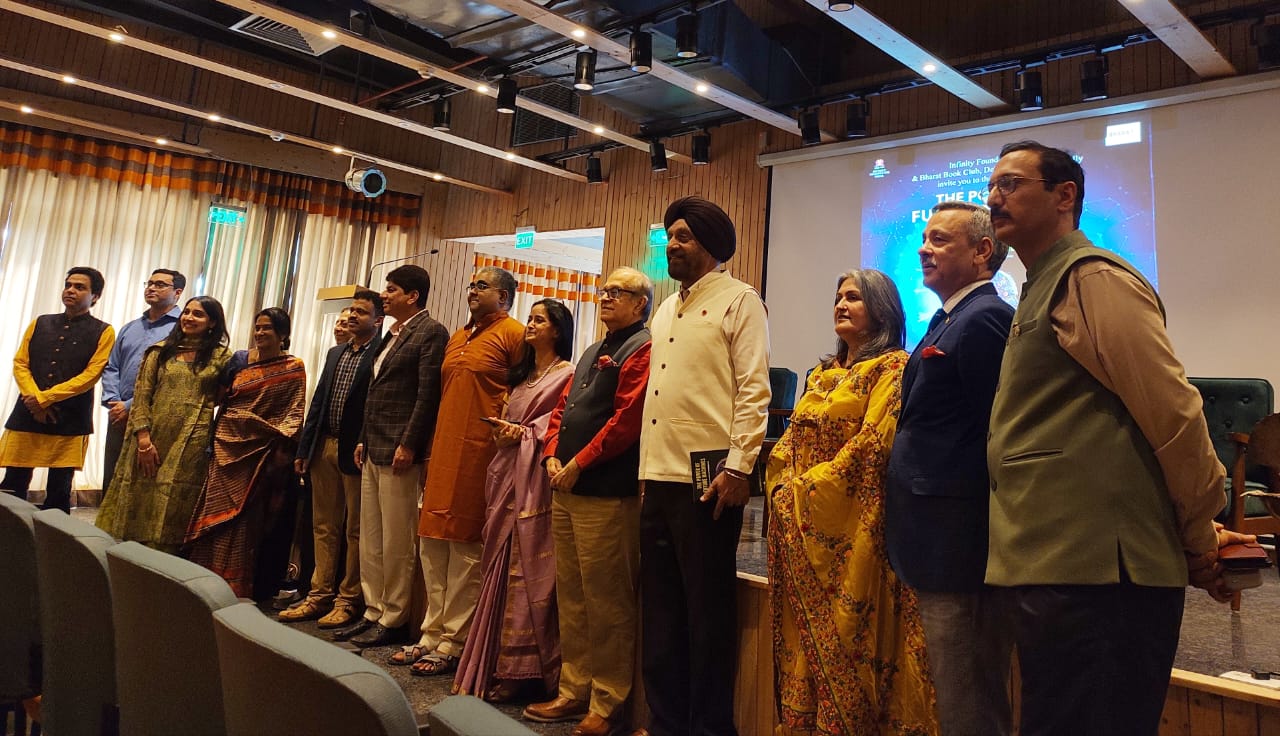
A book, ‘The Power of Future Machines’, was launched in the Hindu College’s Sushila Devi Auditorium in Delhi on Tuesday by Infinity Foundation of India and Bharat Book Club.

At the event, the co-editors of the book, Rajiv Malhotra, TN Sudarshan, and Manogna Sastry were present along with guests and several authors including Lt Gen PJS Pannu, Major General (Retd) Lav Bikram Chand, Raj Kumar Sharma, as well as Col Manik Anand, PO (AS), Ministry of Defence.

The book includes nine chapters with topics like “The Winner of the Fourth Industrial Revolution Takes It All: India’s Role in the Battle for World Dominion”,  “The Impact of AI on Freedom of Speech: Examining the Problem of Bias in Content Moderation”, “Artificial Intelligence for National Security” and “AI-MING for a Theory of Everything.”

THE BOOK

It is a collection of expert essays that talks about the future impact of Artificial Intelligence (Al) in various fields. The experts engage and discuss the potential effects of Al in this book while sharing their unique perspectives with the readers.

The Power of Future Machines. (Image: rajivmalhotra.com)

Additionally, the essays talk about how Al will influence policymaking, both in specific fields of expertise and its impact on mankind as a whole.

Sastry, who is currently the Team Leader, Research, at Infinity Foundation India, told News18 that it took more than 2 years to complete this book, which is now available on Amazon. Meanwhile, Sudarshan, who is a computer scientist and specialised in AI, as well as related technologies, stated that about 100 authors, from India as well as abroad, shared their views through the essays included in the book.

On the back cover, Lt Gen PJS Pannu, PVSM, AVSM, VSM (Retd), Former Deputy Chief of Indian Integrated Defence Staff (Operations), who was present at the launch event, wrote: “Threats devoid of emotions in hu-machine (a combination of human and machine) would need careful responses and regulating mechanisms.”

“Those who do not care to adapt shall be first recipients of such intimidation … the greed for speed will encounter a pushback by nature. Humans need new definitions of … hope, compassion, and happiness to program machines of the future,” he added.

FOCUS POINTS

Authors and guests at book launch of The Power of Future Machines. (Pic/News18)

During the launch, several key guests shared their views on the usage of AI. While talking about the book, Major General (Retd) Lav Bikram Chand highlighted that if AI is not used responsibly, it can destroy any individual or even a nation. He said: “Even though it is enlightening, at the same time it is also very scary.”

Malhotra, who is a researcher and computer scientist specialising in AI, dived deep into the concerning factors of such technological advancement.

One of those concerns highlighted by the tech expert was the “Digital Caste System”.

He said: “You should stop thinking about the traditional caste system as a whole new caste system is coming which is based on new criteria of who controls the algorithms, who has privacy, who is being manipulated without even being conscious that they are being manipulated and who is being denied rights to access various things.”

According to him, only a few people at the top of some companies control these algorithms. They set the criteria of what is true and false and what type of ideology to support.

While talking about military and defence, he said that not taking the AI weaponry strategic advantage seriously can be very costly at a time when India is “10 years behind China”.

“There are a few things that are related to AI such as quantum computing which allows breaking all the security codes. So there is a race between the US and China to see who can do it for having an advantage even for a short window in which they can do a lot of mischiefs,” he highlighted.

One particular concern has been raised during this event which is the bias of AI. Malhotra specifically talked about ChatGPT being biased and when he spoke to the people behind OpenAI, they said that “your culture can help it in training to make it ok”.

While stating his argument, Malhotra said: “If you don’t train it, it will continue to have that bias, and if you train it, you are doing the free service of training their algorithm, making it smarter to know you and the more it knows you, the more it will know how to manipulate you.”

The problem according to the tech expert is that India doesn’t have its own platforms such as an operating system, language model, search engine, and social media. So these gaps actually show that while Indians are more dependent on some other companies’ services, there is a risk of compromising the data of the citizens.

“The issues are very large and complex. So to take it forward we need more people talking about the risks and we will continue doing more work highlighting these issues,” he noted.

Read More
All Articles, Articles by Rajiv, News

राजीव मल्होत्रा का कॉलम:नस्लवाद के सिद्धांत से भारत को बांटने की कोशिशें जारी

राजीव मल्होत्रा का कॉलम:नस्लवाद के सिद्धांत से भारत को बांटने की कोशिशें जारी

3 वर्ष पहले

लगभग बारह वर्ष पूर्व मैंने एफ्रो-दलित सिद्धांत का तब प्रतिकार किया था, जब वह अपनी प्रारंभिक अवस्था में ही था। इस सिद्धांत के अनुसार दलित भारत के अश्वेत (ब्लैक) हैं और गैर-दलित श्वेत (वाइट) हैं। ऐसा मानकर यह सिद्धांत दावा करता है कि भारतीय समाज की जाति-व्यवस्था नस्लवाद (रेसिज़्म) के समतुल्य है। अपनी पुस्तक ‘ब्रेकिंग इंडिया’ में मैंने अमेरिका से संचालित और आर्थिक रूप से पोषित इस एफ्रो-दलित परियोजना की कार्यप्रणाली को समझाया था।

यह परियोजना अमेरिकी नस्लवाद के सिद्धांत के उपयोग द्वारा भारत के सामाजिक मतभेदों को भड़काकर हमारे देश को विखंडित करना चाहती है। इस पर भारतीयों को प्रतिक्रिया देनी चाहिए कि दमन का इतिहास वास्तविकता में किसी अन्य निष्कर्ष की ओर संकेत करता है। जिस प्रकार श्वेत अमेरिकियों द्वारा अश्वेतों का शोषण किया गया, उसी प्रकार भारत में हिंदुओं का शोषण हजार वर्ष तक विदेशी आक्रांताओं और यूरोपियों ने उपनिवेशीकरण द्वारा किया।

हिंदुओं को हिंदू संस्कृति और इतिहास के बारे में अमेरिका के अश्वेतों को समझाकर, उनके साथ मिलकर एक समान आधारभूमि खोजनी चाहिए थी। इसाबेल विल्करसन एक प्रमुख अश्वेत विद्वान हैं। कुछ समय पूर्व उन्होंने एक पुस्तक लिखी जिसमें एफ्रो-दलित समुदाय को विश्व में उत्पीड़ित वर्गों के केंद्रबिंदु के रूप में दर्शाया। ‘कास्ट : दि ओरिजिन्स ऑफ अवर डिस्कंटेंट्स’ शीर्षक वाली यह पुस्तक घोषणा करती है कि अनेक प्रकार के नस्लवादों में कास्ट (भारतीय जाति-वर्ण व्यवस्था के अर्थ में) केवल एक प्रकार मात्र नहीं है।

कास्ट तो वह रीढ़ की हड्डी है, जिस पर सम्पूर्ण रेसिज़्म का सिद्धांत खड़ा है। उनका मानना है कि अंग्रेज कास्ट की धारणा को वैदिक ग्रंथों से सीखकर अमेरिका में ले गए और फिर उसके आधार पर उन्होंने अमेरिका में अश्वेतों के विरुद्ध रेसिज़्म का ढांचा खड़ा किया। यह पद्धति यूरोप में भी फैली, जिसके फलस्वरूप नाजियों द्वारा यहूदियों का जनसंहार (होलोकॉस्ट) हुआ।

इस प्रकार विल्करसन यह अटपटा दावा करती हैं कि विश्व में रेसिज़्म का मूल कारण भारत की जाति-व्यवस्था है। उनके द्वारा तर्क दिया जाता है कि जाति कर्म सिद्धांत के कारण अमिट रूप से हिंदू धर्म के साथ जुड़ी है। मुझे भारत के दलितों और अमेरिका के अश्वेतों से सहानुभूति है। लेकिन विल्करसन की मान्यता से मुझे यह समस्या है कि यह अमेरिकी इतिहास के चश्मे का उपयोग करके दलितों से संबंधित मुद्दों को देखने का प्रयास करती है।

भारतीय सामाजिक व्यवस्था का इतिहास बहुत जटिल है और इसे ऐसे एकांगी विश्लेषण द्वारा नहीं समझा जा सकता। यदि इस सिद्धांत की सीमा मात्र शैक्षणिक संस्थाओं तक ही होती तो भी ठीक था, किंतु विल्करसन के इस सिद्धांत को अमरीकी सोशल मीडिया में बड़ी लोक प्रसिद्धि मिली है। विल्करसन पुलित्ज़र पुरस्कार विजेता हैं और उनकी किताब न्यूयॉर्क टाइम्स की बेस्टसेलर पुस्तकों की श्रेणी में पहला स्थान प्राप्त कर चुकी है।

ओप्रा विनफ्रे ने भी उनकी पुस्तक का प्रचार किया है। यह सिद्धांत अब ब्लैक लाइव्स मैटर आंदोलन और नई वोक सोशल जस्टिस विचारधारा का केंद्रीय अंग बन चुका है। इसे एक स्वतंत्र अभिव्यक्ति या सोच के रूप में माना जा सकता था यदि दलितों से अश्वेतों और ब्राह्मणों से श्वेतों की तुलना को एक वाद-योग्य परिकल्पना के रूप में प्रस्तुत किया जाता।

किन्तु इसे एक निर्विवाद तथ्य के रूप में प्रस्तुत किया जा रहा है। परिणामस्वरूप सामाजिक न्याय आंदोलन हिंदुओं से द्वेष के आंदोलन में परिवर्तित हो चुका है। भारत को विश्व-दमन के स्रोत के रूप में दर्शाया जा रहा है। इस विचार-सरणी का प्रतिकार करना जरूरी है।

पश्चिम का सामाजिक न्याय आंदोलन हिंदुओं से द्वेष के आंदोलन में परिवर्तित हो चुका है। दलितों से अश्वेतों और ब्राह्मणों से श्वेतों की तुलना करके भारत को विश्व-दमन के स्रोत के रूप में दर्शाया जा रहा है।

(ये लेखक के अपने विचार हैं।)

Read More
All Articles, Articles by Rajiv, News

Opinion | Why India’s IITs Are Being Targeted In West For Pushing Meritocracy

Opinion | Why India’s IITs Are Being Targeted In West For Pushing Meritocracy

Harvard University professor Ajantha Subramanian has accused the IITs of perpetuating caste oppression

In her influential book The Caste of Merit: Engineering Education in India, Harvard University’s professor Ajantha Subramanian has accused the IITs of perpetuating caste oppression. The crux of her argument is that the structure of IITs favours Brahmins and upper castes and is oppressive towards the lower castes. Therefore, even if entrance examinations are open to all and there is no discrimination in how marks are awarded, they are still guilty.

She traces the oppressive structure to the period of British rule in India. Prior to that, engineering was considered a hands-on job that was suitable for lower caste people. This changed during the British period because they split the discipline into its theoretical and hands-on aspects. With Brahmins conspiring to grab the theoretical side, only the hands-on work remained for lower castes. Since Brahmins were intelligent people, this kind of stratification also served the British interest, because they could use their skills in administration. It also opened the door for Brahmins to make money as technocrats and industrialists, which was not possible in their traditional roles. Therefore, the whole arrangement was highly beneficial for Brahmins while it hurt lower castes.

This part of her thesis is substantially correct. Infinity Foundation has documented the skills of many lower caste people in its History of Indian Science and Technology book series. What Subramanian fails to uncover however is the lack of initiatives by the Indian government since independence to take corrective measures. The British system was not designed to skill the lower castes but was intended to develop a battery of clerks that would help them rule the country.

Rather than bringing a change in the education system invented by the British, successive governments have continued with it. This has resulted in a loss of skill at the hands-on level because getting an education does not help people get jobs at that level. It also does not attract people who may have an aptitude for such work simply because it doesn’t pay. On the other hand, the expansion of engineering into computer sciences has further expanded the theoretical side, creating additional opportunities for the people engaged in theory. Therefore, the flow of human capital based on skills and aptitude is blocked.

Subramanian’s contention is that the only way to correct this unfortunate circumstance is by dismantling the IITs. It doesn’t matter that these centres of excellence produce the most talented tech people that the world recognises. It also doesn’t matter to her that these institutions are lifting the value of Brand India all over the world. She cannot tolerate the success of IIT people either in India or in Silicon Valley, or the way that they are spreading their influence all over the world through their professional networking. According to her, this spread of influence is pernicious because it is an expansion of Brahmin power.

Her theory assumes that lower caste people lack merit, because of which they cannot pass the entrance exam and qualify as IIT engineers. Therefore, she declares the entrance exam itself to be a sham. It is not based on true meritocracy because it excludes certain people. She does not support changing the system to treat equally the hands-on and theoretical students, even though that would remedy her claim of bias. Nothing less than rejecting meritocracy would satisfy her.

Subramanian’s problem with the IITs and her solution is linked to the Marxist ideology that she prescribes to. Since Marxism requires you to dismantle existing structures to make way for a new one and since IITs are well-established structures, she is calling for their destruction.

Details of her thesis and our rebuttal are in the book, Snakes in the Ganga. Visit SnakesInTheGanga.com.

Read More
All Articles, Articles by Rajiv, News, Snakes in the ganga

Rebutting The Latest Woke Attack On Hindu Universalism By Western Academia

Rebutting The Latest Woke Attack On Hindu Universalism By Western Academia

  • Sundaram is completely wrong when she alleges that we are engaged in “efforts to censor discussions on caste violence”.
  • She is blind to the fact that ‘wokeism’ is not the only framework in which present-day caste violence can be discussed, and certainly not the best.
  • Sundaram has been tutored by scholars known for selective citing of evidence.

The recent article titled, The neocolonial futurism of US Hindutva, by Dheepa Sundaram, goes to show how much Western academia is being troubled by the book, Snakes in the Ganga, recently published along with my co-author Vijaya Viswanathan.

Besides the factual errors Sundaram makes while naming me as her target, there are more serious issues concerning the manner in which it has been framed using categories of Western Universalism.

Western Universalism is the conscious and unconscious use of Western history, philosophy and social experience as the template presumed to speak for all of humanity.

A complete discussion on the use of such colonial categories is beyond the scope of this brief response, and I have written extensively on that subject before. I shall limit myself here to a few obvious blind spots in Sundaram’s piece.

But before examining her article, I congratulate Sundaram for taking the trouble to capture my thoughts, even though she is constrained to operate within the Western social sciences. Only through such conversations can bridges be built for more useful exchanges in the future.

Since her subject matter concerns the nature of Hindu dharma, I begin by explaining one of the most distinct aspects of its metaphysics.

In sharp contrast with the Abrahamic models that are embedded in Western Universalism, Hindu dharma does not presume an external god separate from the cosmos. Rather, the cosmos itself is nothing other than a manifestation of the supreme being. Nor is there the concept of a devil in this framework, and one must experience everything as forms of the ‘one’.

All particulars are within this universal. All relatives are within this absolute. The appearances of form and functionality are like elements of a play. This divine play, known as Lila, is dynamic and ever evolving. It is the infinite that assumes every finite role in this play.

Beneath the ever-changing Lila lies the unchanging.

Therefore, the shastras (spiritual texts) are of two kinds of truths: eternal truths contained in the shruti texts, and contextual truths contained in the smriti texts.

Correspondingly, there are two realms of human experience. This separation is not so clear in the Abrahamic religions, where the eternal and the contextual have become collapsed into “one book” — frozen permanently. The Abrahamic religions suffer this deep-rooted reductionism that Hindu metaphysics resists.

The implication is that Hindu dharma cannot be homogenised: the divine play has infinite variations, and each form is transitory.

Yet, Sundaram makes the ridiculous allegation that we Hindus are guilty of “deliberate flattening of the historical diversity of Hinduism”. Because we do not subscribe to one closed book, one final prophet, or one deity, the Abrahamic systems have for thousands of years charged us with allegations of polytheism and idolatry.

So how can Sundaram find us guilty of “seeking to enshrine an essentialised, homogenous Hindu identity”. This is an oxymoronic understanding of Hindu dharma.

It is relevant to point out that Chinese and Islamic scholars have each insisted on using their own respective approaches to the social sciences, and each makes its own claim of universalism. Why is it considered wrong if we wish to approach social sciences based on Vedic/Hindu universalism?

To illustrate how we must assert our own approaches to social-political thought, let us discuss the fashionable assault on ‘Hindutva’. This term stands for ‘Hindu-tattva’, which literally means Hindu-essence. Nothing wrong with that.

But critics find it problematic because the term was coined in the context of politics in the twentieth century. The charge is made by many (such as Shashi Tharoor) that Hinduism proper should stay out of politics. They use this view to create a wedge between Hinduism (which they claim to support) and Hindutva (which they fight fiercely).

Let me explain my views on this pivotal issue since Sundaram aligns with the anti-Hindutva camp.

Hindu dharma, like all other faiths, very clearly and explicitly includes the social-political dimension. That is what is called Kshatriya dharma, the dharma of political, military, judicial, and civic roles.

The Ramayana is about bhagwan taking birth as Sri Ramachandra — a Kshatriya king to perform that role. The Mahabharata is about Sri Krishna directing the Kshatriyas to perform their roles.

In the Ramayana, the Kshatriyas must fight an external enemy from another kingdom. In the Mahabharata, the Kshatriyas must fight internal enemies, in fact one’s own cousins.

To delete politics from dharma would mean deleting the agency of the Kshatriyas, and hence rendering both the Itihasa narratives outside the scope of Hindu dharma. This would amount to surrendering the political space to foreign rule, ie, colonisation.

I am not fond of the term ‘Hindutva’ because Hindu dharma more than suffices. But I fully support what it stands for. The Kshatriya roles are critical for Hindus in this era of globalisation.

Historically, all colonisers seek to exterminate the Kshatriyas of a defeated people, in order to render them helpless and dependent on the colonisers.

The defiance of British rule by Indian nationalists (ranging from Mohandas Gandhi to Veer Savarkar) exemplified the modern return of the Kshatriyas.

Those who seek to delete Kshatriyas are in effect paving the way for the recolonisation of Hindu society. I would go a step further and say that modern democracy can be seen as a form of participatory-Kshatriyata in which every adult citizen participates in the political yajna of protecting society.

Another blatant imposition of Western Universalism by the ‘woke’ academy is the way in which the Black/White race relations in America are being universalised and projected on other cultures. Sundaram claims that Hindus have created “a mythologised past” that denies “anti-Blackness”. Her assumption is that Blackness and Whiteness are the appropriate categories for understanding India’s past and present societies.

This is the blunder of Western Universalism being projected on others. I would argue that the concept of White people was peculiarly American and even different from Europe’s identities as English, French, German, Dutch, Italian, et al.

The framing of social problems in the ‘Blackness’ and ‘Whiteness’ grid shows the American colonisation of social sciences, because these categories are intimately linked with the peculiarities of American society and its historical conflicts.  No two societies are the same, and thus no two societies have the same problems.

For example, the highest ideal in America is the individual ego’s freedom to act. This freedom has nothing to do with the ultimate freedom in the Vedic world view, which is freedom from causation. Thus, imposing a framework of power struggles onto a Vedic society is flawed and arrogant to say the least.

Snakes in the Ganga explicitly acknowledges multiple times that social abuse has existed in India, as in every other society. And that it has also found remedies from within the system over the ages.

The Bhagavad Gita and Chandogya Upanishad are examples of numerous resources available for countering the politics of prejudice. And now, once again, there are social inequalities that need to be addressed from within the Indian spiritual and democratic systems.

What is important to note are the numerous differences between Indian and American social histories that cannot be whitewashed. One cannot treat a malady based on a false diagnosis. India’s minorities (Muslims and Christians) came as foreign conquerors who ruled over the native majority of Hindus for centuries.

In contrast, the American Blacks did not come as African conquerors defeating the native White people and ruling over them. The Muslim rulers in India imposed their Persian language and the Christian rulers their English as the official languages of India. They imposed their own foreign social and political structures, named cities and monuments after themselves, and committed genocides that are well-documented.

Despite being numerical minorities, they installed their narratives on the Hindu majority which we are still trying to decolonise. Black Americans are not inheritors of any such past oppression committed by their African ancestors.

A common excuse being given to exempt Muslim invaders as colonisers is that they eventually ‘settled’ in India starting with Babur (several centuries after the Islamic invasions started). But nobody has given the White Americans of European origin the same free pass for the oppression of the native Americans, even though the Whites did become settlers in America.

White people’s atrocities and accomplishments are separately listed, and the atrocities are not denied. But there is a double standard in the treatment given to India’s Muslim colonisers: only their contributions are given prominence. Their genocides of Hindu natives, though documented by their own scribes as great accomplishments against infidels, are deemed politically incorrect to mention.

I wish to emphasise that India’s present-day Muslims and Christians should not bear any responsibility for the past atrocities committed by previous generations belonging to the same faiths. This is just like saying that whatever my past ancestors might have done is not my personal burden and responsibility.

Just like I want to be judged only by my own personal conduct, so also, I must judge others solely by their own personal conduct. This is why I oppose blame games in which oppressors/oppressed are assigned based on their respective past ancestors.

Regarding the internal social structures of India and the abuses therein, Snakes in the Ganga devotes chapter 6 (the largest chapter by far) to discuss this history. It explains how social structures have changed and evolved, varied from one region to another, and one era to another. It explains the different notions of varna, jati, and caste, and the reductionist blunder of collapsing these into what has now become “the caste system”.

Clearly, Sundaram is completely wrong when she alleges that we are engaged in “efforts to censor discussions on caste violence”, or that we are using “the language of decolonisation and anti-racism to inoculate themselves against charges of discrimination”.

She is also blind to the fact that ‘wokeism’ is not the only framework in which present-day caste violence can be discussed, and certainly not the best. For reference purposes, Mohandas Gandhi insisted on using the Hindu social structures as his framework to reform its abuses. This was decades before the BJP (Bharatiya Janata Party) came into existence.

Sundaram has been tutored by scholars known for selective citing of evidence. When evaluating India’s track record of hospitality towards foreign migrants, they conveniently forget that Hindus have an unprecedented track record of giving refuge to Jews, Iranian Zoroastrians, Syrian Christians, Tibetans, etc. But when foreign migrants are denied entry in an already-overcrowded country, the alarm bells go off with outrageous charges of fascism.

For the record, I would like to say that I have never accepted Savarkar’s position that Hinduism is a race. That would negate my views on the notion of Vedic/Hindu Universalism, which like all other universalisms is, by definition, beyond any race, geography, space-time boundaries — applicable universally to all humankind.

The core of Vedic teachings on the nature of the self, and the theories of karma and reincarnation, become meaningless if one were to consider them applicable only to some specific race of humans.

In fact, the same metaphysical principles apply to all life forms, including non-humans. Hence, a race-based reductionism is totally unacceptable to me.

The Hinduphobic lobby is especially bent on wanting to contain Hindu dharma geographically and curtailing its globalised expressions.

However, the Kurukshetra (the metaphorical battlefield where the Kshatriyas must operate) has become global. All other faiths operate globally.

So why does Sundaram find it troubling that Hindu diasporas want to “leverage transnational relationships with India”? The Abrahamic religions and the Global Left certainly consider the entire world their playing field.

Western academics must stop treating Hindus as native informants — even though we live among them as their doctors, classmates, neighbours, chefs, politicians, scientists, relationship partners, and in every imaginable capacity as Americans.

Is this a posture of unconscious racism? After all, other dual/hyphenated identities of Italian-Americans, Irish-Americans, Jewish-Americans, Muslim-Americans, etc, are seen as normal. So why is there something wrong when Hindus from India introduce their rich heritage as part of the American tapestry?

I wish to encourage Sundaram and others like her to continue this back-and-forth conversation with Hindu intellectuals.

There are so many issues raised in our book that ought to be debated. For instance, I list the following topics as food for thought by Sundaram and her peers:

  1. What are the similarities and differences between Blacks in America and Dalits and other minorities in India, both historically and in contemporary terms?
  2. In Marxist terms, should all Muslims be treated as victims and designated as a “protected class”? Or should it be more nuanced and dependent on individual context?
  3. Just like the aggressive calls by woke academicians to dismantle Hindutva/Hinduism, why is there no equivalent call to dismantle Christianity and Islam? Their record of atrocities is certainly far greater.
  4. Is the designation of Hindus as “white adjacent” false and arbitrary? One should not deny that Indian Hindus have a history of being oppressed by foreign oppressors.
  5. Though wokeism champions indigenous people in other continents, why does it fail to provide the same support to Hindus as the indigenous people of the Indian subcontinent?
  6. Is French President Emmanuel Macron right in claiming that rights and liberty should be at the level of individuals and not be given to groups and identities? Why do wokeists not want to debate the differences between classical liberalism and wokeism — explained in Snakes in the Ganga?
  7. Are India’s laws on reservation more woke than American attempts to bring equity of outcomes? Why is there no discussion on this?
  8. Why are wokeists selective in the application of intersectionality? Aren’t poor Brahmins today the worst hit and beyond any possible privilege accrued due to caste?

Before Sundaram and others could open such conversations, they would need to tackle the widespread ‘cancel culture’ in their own camp. It is amazing that she writes: “Only Hindu ‘insiders’ can speak about Hinduism”.

The facts are opposite. We have been inviting the opponents to discuss in public forums. In fact, Prof Bal Ram Singh invited Harvard’s Suraj Yengde numerous times to participate in my book discussions at Harvard a couple of weeks ago. But all his attempts fell on deaf ears. No interest from Yengde to get involved. They prefer to hit and run.

When I saw this latest article by Dheepa Sundaram, I sent messages to the journal where it appeared, requesting a chance to post a response. This seems fair since the article names me as the central protagonist. But no such opportunity has been granted.

In this regard, the difference between Hindu tradition and wokeism is poignant. There were no incidents in Hindu history of burning the books of those one disagrees with. No injunctions by god to harm infidels.

In fact, in the Bhagavad-Gita, Sri Krishna’s final message to Arjuna may be summed up as follows: I have answered your questions and explained what you need to know. But now you may do as you please.

Multiplicity and even paradox in thought have been a cornerstone of the Hindu tradition, since Hindu Universalism truly and strongly aligns with the plethora of possibilities that constitute reality and truth.

Read More