

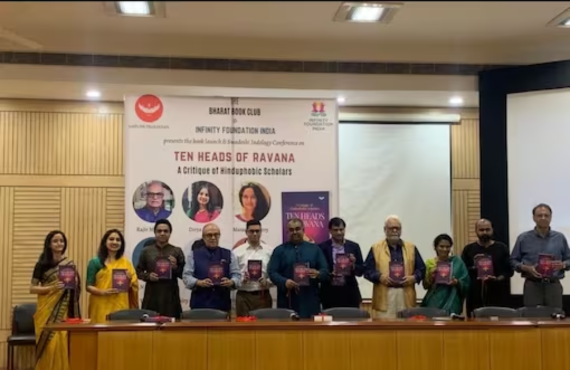
Opinion | ‘Ten Heads of Ravana’: A Brilliant Takedown of Eminent Left-Oriented Scholars
For the past two centuries, Indology has been controlled by Western scholars and institutions, which have applied Western methods to study Indian civilisation. Infinity Foundation has, for the past several years, been at the forefront in the field of civilisational studies, applying the lens of ‘Dharma’ to examine a broad range of topics. “The present book — Ten Heads of Ravana — is the latest offering from our team of brilliant scholars, scholars I have mentored”, says Rajiv Malhotra.
The title of this collection, Ten Heads of Ravana, has been chosen with care. The use of ‘Ravana’ is intended as a parody and not literally. The metaphorical resemblances are clear — the historical Ravana disrupted society’s Hindu structures, and the ‘heads’ chosen for this book are considered by Hindus, today, to be individuals doing something similar, but intellectually and not with physical violence.
The ten scholars featured in this book are powerful in the academic discourse today; they have worked diligently most of their lives to develop their intellectual ‘weapons’, and their impact is not to be trivialised. There is no intention on the part of the authors to attack the individuals at a personal level, but rather to cast their work in the framework from the perspective of Dharma. The authors of these essays have taken care not to engage in any ad hominem attacks or unprofessional takedowns of the individual scholars. Ramayana, one of the greatest mahakavyas of Bharat, shows us the nature of Ravana as the mighty king of Lanka and the main antagonist of the epic. He is believed to have learned the Arthashastra from Shukracharya, was adept at the use of maya, and won boons from Brahma and Shiva.
The ten contemporary scholars in this book have been chosen because their work includes aspects that many Hindus today consider adharmic, just as the historical Ravana was perceived in his time. And just as the historical Ravana defended his positions, so did the ten scholars. The authors of this book respect the opponents’ right to intellectual freedom and merely wish to offer rebuttals so the readers can decide for themselves.
Consider, for example, the article on Romila Thapar. She has been one of India’s foremost historians, having held control of premier national educational and research institutions to influence academic discourse and government policies over decades. Anurag Sharma, in his brilliant essay, refutes Thapar’s historiographical assumptions by providing strong counterexamples from Indian history.
The Sanskrit scholar Sheldon Pollock has been the subject of Rajiv Malhotra’s book, ‘The Battle for Sanskrit’. Several volumes were published from the series of Swadeshi Indology conferences held in Chennai and New Delhi by Infinity Foundation India. The editor of these volumes, Professor KS Kannan, presents a powerful essay on Pollock’s major arguments and modus operandi. Kannan shows that despite being a scholar who makes his living out of Sanskrit, Pollock denies the very nativity of Sanskrit to India and calls the language dead despite many proofs to the contrary.


